Vulture, the NY Mag entertainment blog, spoiled a major event of season five of The Wire this a.m. I wouldn't care except that the spoiler was in the post headline, which I read in my feedreader, and which I cannot now unread. I will not link to them, for obvious reasons. You can find the post if you want to.
I wrote to the editor the following email:
"You spoiled The Wire in your headline! Not cool!! Seriously, don't do this again. I'll stop reading Vulture. I'm trying to be nice. Imagine what I really want to say to you."
And I twittered:
"don't read NY mag's Vulture blog headlines in your RSS reader today if you are avoiding spoilers for The Wire [cursing them under my breath]"
An hour and twenty-five minutes later, Vulture ran another Wire item, with a second spoiler!
I wrote to them again:
"Twice in one day putting the plot summary in the post title! I just unsubscribed from your feed."
Karina Longworth, perhaps after reading my tweet, wrote:
"Vulture seems to be earning a reputation for putting spoilers in the headlines. If they keep doing it, it must be good for traffic, no?"
Then I received this email from the Vultures:
"Sorry to hear you're so upset. But we're an entertainment blog; we write about TV shows all the time. In the same way that sports Websites can't be worried about spoiling the scores of basketball games for people who Tivoed the game and plan to watch it later, we can't be worried about spoiling plot points of a show that has already aired at its normal viewing time."
I think this speaks for itself, but allow me to state the obvious. These people are Wrong and, you know, really really Wrong, and everyone should stop reading their blog.
Showing posts with label internet culture. Show all posts
Showing posts with label internet culture. Show all posts
1/28/2008

9/20/2007
A don't tase me, bro t-shirt, and another don't tase me, bro t-shirt. (context)
There is nothing on the web better than lolsecretz.
Slate has a TV week series, including a slideshow on the history of the laugh track (previously) and a piece on TV character blogs. I've never gotten into these, though I do follow Xander Harris's Twitterstream.
The first ep of this season's Friday Night Lights is streaming at Yahoo TV, but I want to wait to watch it on a real TV. We'll see how patient I can be.
Here's a blog profile of composer Evan Lurie, formerly of the Lounge Lizards and now a key contributor to The Backyardigans, the brilliant children's program on Nick/Noggin that has a different style of music for each episode.
Boing Boing links to a 60 Minutes segment from 1978 about video piracy, including an interview with the late Jack Valenti. How little has changed in 30 years in the way the mainstream press approaches this kind of story. YouTube: part one, part two.
And Back to You is the first show of the new TV season that has surprised me. It's reminiscent of so many old faves, and not just Cheers and Frasier. The newsroom-family is reminiscent of MTM and Murphy Brown and the rapport between the leads is in the Moonlighting and Will & Grace tradition. Maybe part of what I like about it is the positive associations, but the talent is certainly there. In addition to its writing and performances, one thing in particular that I admire is that it has long scenes, something you rarely find in TV of any genre these days (some cable dramas are exceptions, though not The Sopranos). I hope this is a sign of a trend reversing itself. The traditional sit-com is a form that works, and it has a lot of life left in it.
There is nothing on the web better than lolsecretz.
Slate has a TV week series, including a slideshow on the history of the laugh track (previously) and a piece on TV character blogs. I've never gotten into these, though I do follow Xander Harris's Twitterstream.
The first ep of this season's Friday Night Lights is streaming at Yahoo TV, but I want to wait to watch it on a real TV. We'll see how patient I can be.
Here's a blog profile of composer Evan Lurie, formerly of the Lounge Lizards and now a key contributor to The Backyardigans, the brilliant children's program on Nick/Noggin that has a different style of music for each episode.
Boing Boing links to a 60 Minutes segment from 1978 about video piracy, including an interview with the late Jack Valenti. How little has changed in 30 years in the way the mainstream press approaches this kind of story. YouTube: part one, part two.
And Back to You is the first show of the new TV season that has surprised me. It's reminiscent of so many old faves, and not just Cheers and Frasier. The newsroom-family is reminiscent of MTM and Murphy Brown and the rapport between the leads is in the Moonlighting and Will & Grace tradition. Maybe part of what I like about it is the positive associations, but the talent is certainly there. In addition to its writing and performances, one thing in particular that I admire is that it has long scenes, something you rarely find in TV of any genre these days (some cable dramas are exceptions, though not The Sopranos). I hope this is a sign of a trend reversing itself. The traditional sit-com is a form that works, and it has a lot of life left in it.
6/02/2007

David Remnick in the New Yorker pays tribute to The Sopranos, "the richest achievement in the history of television." I wonder about the extent to which Remnick has canvassed this history. Has he watched all nineteen eps of My So-Called Life? Would he so confidently assert the equivalent for any other form, for a film or a play or a novel or a concerto? Or is it that television is so generally devalued that any outstanding work seems like it could be, unproblematically, best evs?
Battlestar is calling it quits after one more season. Another welcome blow at the infinity model. I really want to like the show again, so I'm looking forward to the final season, the "third act," and not giving up yet despite my strong negative reaction to the ending of the season just past.
Movie Midpoints is a screen capture quiz using the middle frame of each film. I do badly at these things, so I'm glad that it comes with answers. I think I might do better with larger images, but it's still fun.
Judd Apatow and Seth Rogen are interviewed on Fresh Air about Freaks and Geeks and Knocked Up. See also this bunch of interviews etc. in Wired.
TechCrunch sez Facebook is the It website, the new Google: "Much of what we know as 'Web 2.0' will eventually be rebuilt on top of Facebook." The story here is the launch of Facebook Platform, which integrates all kinds of other functionality--Twitter, Last.fm, etc.--into one's Facebook page. Read all about it at the Facebook blog. It seems now that the age barrier is crumbling as old folks flock to the site (e.g., see Jeff Jarvis's gushy thoughts). It's certainly not too late for you, old-timer latecomers.
Jimmy Wales is interviewed by Charlie Rose (beginning around 19:45) about the future of Wikipedia and the way money is made online. He compares Facebook and MySpace around 24-25 min., praising the former. He talks about open source around 27-28, praising Firefox in particular.
And there will soon be 300,000 books published in the USA each year, reports Publishers Weekly. One of these days, among these will be mine. I just signed a contract with Columbia UP for my volume on indie cinema, loosely based on my dissertation. Keep your eyes peeled.
5/04/2007
At the end of this Techcrunch article about Flickr replacing Yahoo! Photo, it mentions that Flickr users will soon be able to upload videos. Not sure what to make of this at the rumor stage, but it could mean some pretty significant changes for both Flickr and web video. Imagine how different YouTube would be with Flickr's interface, its greater/better social affordances, and its generally more civilized community standards. Stay tuned.
5/02/2007
My So-Called Life to return to DVD, but what about the extras? (via)
The CW: has the sum been less than the parts?
Does 24 need reinvention?
Do sweeps periods still matter?
Google: ready for a fight?
Perez: past the tipping point?
American Gladiators nostalgia, anyone?
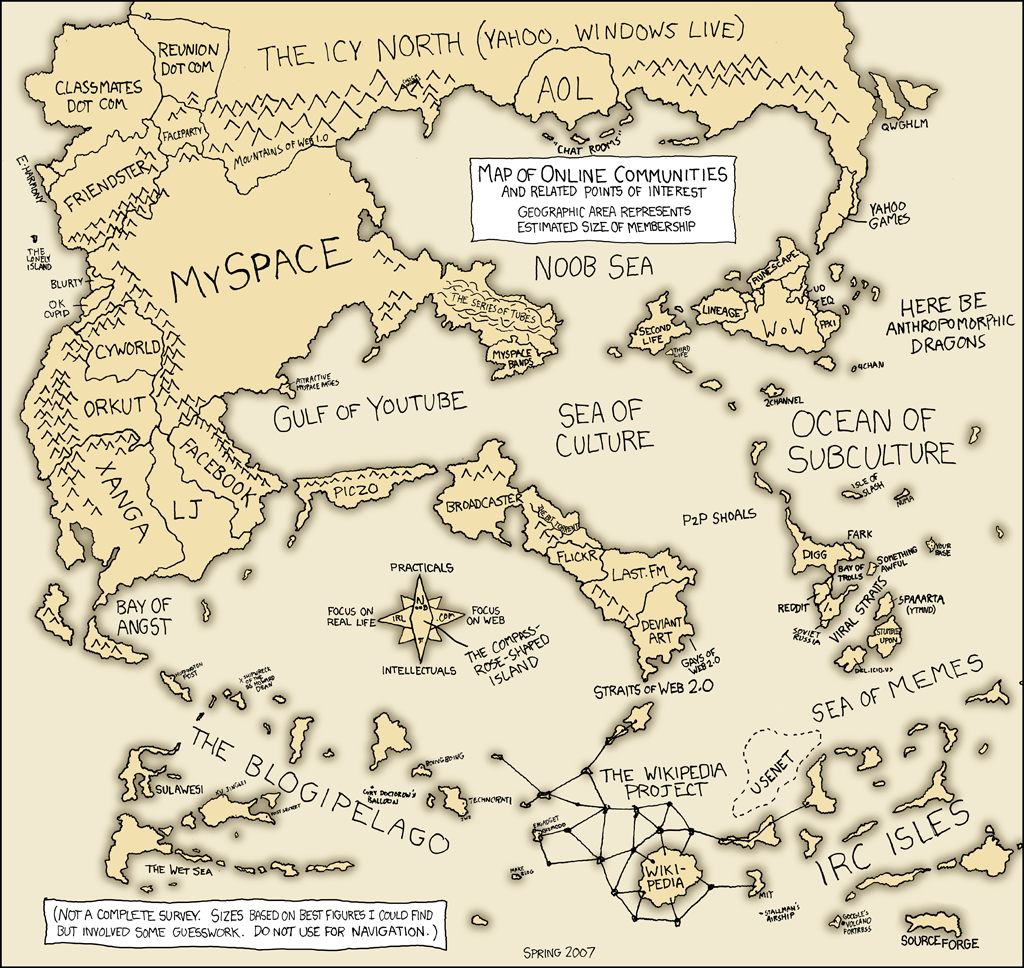
Finally, this map of online communities is my favorite thing of the day.
The CW: has the sum been less than the parts?
Does 24 need reinvention?
Do sweeps periods still matter?
Google: ready for a fight?
Perez: past the tipping point?
American Gladiators nostalgia, anyone?
Finally, this map of online communities is my favorite thing of the day.
4/12/2007
NYT: "Not all is well with the Weinstein Company."
Slate is a-Twitter.
Jimmy Kimmel 1, Gawker 0.
Recently on Fresh Air: Jake Kasdan, Mike White, Peter Berg.
Ken Levine reports from the studio audience of Tuesday nite's Idol. Snarky but appreciative. Lisa de Moraes's WaPo blog is lively reading, too, if you're into this stuff.
And if it's in your power, please make these things go away asap: Imus, O'Reilly, the blogger code of conduct, Daniellyn, and Justin.tv.
Slate is a-Twitter.
Jimmy Kimmel 1, Gawker 0.
Recently on Fresh Air: Jake Kasdan, Mike White, Peter Berg.
Ken Levine reports from the studio audience of Tuesday nite's Idol. Snarky but appreciative. Lisa de Moraes's WaPo blog is lively reading, too, if you're into this stuff.
And if it's in your power, please make these things go away asap: Imus, O'Reilly, the blogger code of conduct, Daniellyn, and Justin.tv.
3/28/2007
Tumblr and the Immersive Internet
For some people it's hootch or craps or Lifetime movies. Lately for me it's these nifty web 2.0 apps. I can't hear even the vaguest hint of hype about a single one of these things without signing myself up. I was already neck deep in blog, flickr, and del.icio.us and that seemed like quite enough. Turns out Silicon Valley was just getting started with me. I started editing Wikipedia pages when I found things that needed work. I've already linked here to my documents on Scribd. I became dabbler in Digg, I've been known to Stumble, and there is a Facebook page with a goofy picture of me on it, search if you must. I have a MySpace though there's nothing there and the only MySpacers who friend me are girls who seem to think I might be interested in, you know. And there's YouTube. I shot some home videos and posted them there. I'm not going to link to them because my sister was embarrassed enough when her third-graders discovered them and she's not looking for more exposure.
And what about RSS? Most earthlings seem to manage without, but these days I'm using three separate RSS apps. NetNewsWire Lite is the one I use most often at home on my desktop computer because it's fastest. (I am subscribed to 285 feeds, which seems like too many.) Netvibes is another I like because it shows me so much in one place and it's just so awesome and cool. And Google Reader works well when I'm on a computer away from home and want to scan just a few feeds in a short period of time (Netvibes takes a little longer to fire up).
Twitter! How did I ever manage without twitter! I love it so much I signed up my mom! Now she twitters too. Friend her if you like. She does lots of interesting stuff, as you will find out.
Now there's this new web app that I just started playing with called Tumblr. A Tumblelog is a kind of stripped down blog--more like a scrapbook than an essayistic or diaristic blog--and it's a form that's been around awhile. One of its distinctive features is that it has different formatting styles for different types of entries: posts, links, quotes, conversations, pictures, videos. When you find something on the web that you want to share, you add it to your tumblelog, so this makes it similar to a linklog like Kottke or Fimoculous. Tumblr is a new, free, Blogger-style service that allows you easily to create a tumblelog using premade templates. (To view examples, see Tumblr Radar, which aggregates recently updated Tumbls.) And like Twitter and del.icio.us, posting to Tumblr is much easier than creating a blog entry using Blogger (or WordPress or other alternatives). You click "post to Tumbl" on a toolbar button and up comes a window that allows for quick entry. Like Twitter, Tumblr makes posting things to the web very easy, easier than a typical blog. But unlike a blog, a Tumbl lacks many social features like a default setting for a blogroll, comments, trackbacks, profiles, etc. It's easy to use in part because it has a small number of features. But a small number of features is actually a virtue, because it allows you to focus on certain things but not others.
I can foresee the term "blog" fading away or shifting meaning as these new forms like Tumblr and Twitter emerge. Lately so many blogs seem to offer magazine-style content, articles and essays in polished prose. I have written some such entries here. Maybe this very entry. But another form of self-publishing online is more about collecting or curating or tracking an ongoing experience than it is like expository writing or punditry. I want to participate in all of these things, but the blog as it is now may not be the best option for the fast, ongoing, process-oriented web publishing. When I find something online that I want to save or share, I may not have much to say about it aside from, "look at this." The form of the blog and the means of posting to it put pressure on the content to be of a certain quality, to be significant and relatively thorough, and to fit the blog's theme. If you're going to take the trouble to blog it, it had better be good. Often I just want to post things I find, though, that don't rise to this level. Often I want to save or share something about which I have no big point to make, and I feel that pointless (or, more like it, point-poor) blog entries are lame.
So I have been playing around with the Tumblr interface and testing its possibilities. I think it's potentially incredibly useful and fun. I don't know that I want to keep doing it for the long term. Maybe it will get tiring. Who knows. The site I created just yesterday is called Fraktastic in homage to Battlestar Galactica (which just jumped the shark, unfortch). It's nothing much, but it suggests what sort of thing one might do with the tool.
The problem, of course, is that I have too many of these things running at once and I'm going to have trouble keeping track of them all. I can't imagine you want to keep track of them all, either. Maybe what I really need is an integrated personal data stream, a consolidated RSS feed that combines all my stuff. But not all of my stuff really belongs together. My pictures and videos, my Wikipedia work, my scholarly work, my non-scholarly writing (e.g., twitter), etc., don't seem to me to all belong in one omnibus Michael Newman place. I'm not sure why, it just doesn't seem appropriate. Making sense of the relative integration or fragmentation of the personal web experience might be a challenge facing those at work on web apps of the future.
Additional reading:
Emily Chang on the personal data stream, with lots of links.
Kottke on tumblelogs in 2005.
Lifehacker review of Tumblr.
Another Tumblr review, at heyblog, with this intriguing design-y passage:
And what about RSS? Most earthlings seem to manage without, but these days I'm using three separate RSS apps. NetNewsWire Lite is the one I use most often at home on my desktop computer because it's fastest. (I am subscribed to 285 feeds, which seems like too many.) Netvibes is another I like because it shows me so much in one place and it's just so awesome and cool. And Google Reader works well when I'm on a computer away from home and want to scan just a few feeds in a short period of time (Netvibes takes a little longer to fire up).
Twitter! How did I ever manage without twitter! I love it so much I signed up my mom! Now she twitters too. Friend her if you like. She does lots of interesting stuff, as you will find out.
Now there's this new web app that I just started playing with called Tumblr. A Tumblelog is a kind of stripped down blog--more like a scrapbook than an essayistic or diaristic blog--and it's a form that's been around awhile. One of its distinctive features is that it has different formatting styles for different types of entries: posts, links, quotes, conversations, pictures, videos. When you find something on the web that you want to share, you add it to your tumblelog, so this makes it similar to a linklog like Kottke or Fimoculous. Tumblr is a new, free, Blogger-style service that allows you easily to create a tumblelog using premade templates. (To view examples, see Tumblr Radar, which aggregates recently updated Tumbls.) And like Twitter and del.icio.us, posting to Tumblr is much easier than creating a blog entry using Blogger (or WordPress or other alternatives). You click "post to Tumbl" on a toolbar button and up comes a window that allows for quick entry. Like Twitter, Tumblr makes posting things to the web very easy, easier than a typical blog. But unlike a blog, a Tumbl lacks many social features like a default setting for a blogroll, comments, trackbacks, profiles, etc. It's easy to use in part because it has a small number of features. But a small number of features is actually a virtue, because it allows you to focus on certain things but not others.
I can foresee the term "blog" fading away or shifting meaning as these new forms like Tumblr and Twitter emerge. Lately so many blogs seem to offer magazine-style content, articles and essays in polished prose. I have written some such entries here. Maybe this very entry. But another form of self-publishing online is more about collecting or curating or tracking an ongoing experience than it is like expository writing or punditry. I want to participate in all of these things, but the blog as it is now may not be the best option for the fast, ongoing, process-oriented web publishing. When I find something online that I want to save or share, I may not have much to say about it aside from, "look at this." The form of the blog and the means of posting to it put pressure on the content to be of a certain quality, to be significant and relatively thorough, and to fit the blog's theme. If you're going to take the trouble to blog it, it had better be good. Often I just want to post things I find, though, that don't rise to this level. Often I want to save or share something about which I have no big point to make, and I feel that pointless (or, more like it, point-poor) blog entries are lame.
So I have been playing around with the Tumblr interface and testing its possibilities. I think it's potentially incredibly useful and fun. I don't know that I want to keep doing it for the long term. Maybe it will get tiring. Who knows. The site I created just yesterday is called Fraktastic in homage to Battlestar Galactica (which just jumped the shark, unfortch). It's nothing much, but it suggests what sort of thing one might do with the tool.
The problem, of course, is that I have too many of these things running at once and I'm going to have trouble keeping track of them all. I can't imagine you want to keep track of them all, either. Maybe what I really need is an integrated personal data stream, a consolidated RSS feed that combines all my stuff. But not all of my stuff really belongs together. My pictures and videos, my Wikipedia work, my scholarly work, my non-scholarly writing (e.g., twitter), etc., don't seem to me to all belong in one omnibus Michael Newman place. I'm not sure why, it just doesn't seem appropriate. Making sense of the relative integration or fragmentation of the personal web experience might be a challenge facing those at work on web apps of the future.
Additional reading:
Emily Chang on the personal data stream, with lots of links.
Kottke on tumblelogs in 2005.
Lifehacker review of Tumblr.
Another Tumblr review, at heyblog, with this intriguing design-y passage:
I’m sure you’ll agree that the world hardly needs another blogging or meta-blogging service, but it’s worth signing up for Tumblr just to check out its design. Like online portfolio service Carbonmade, it nails some current design trends—big fonts, gradients, “simplicity”, clever writing—in really thoughtful and appropriate ways, without looking merely trendy. In both applications, stuff you do once is big and easy, and stuff you do often is accessible and quick. Even the sign-up confirmation email is lovely. It’s also nice that Tumblr’s not overly Ajax-y, too, except where it’s really useful (like previewing your design changes).
3/19/2007
Twitter has been running really slow, and you can imagine the vast multitudes eagerly reporting their quotidian events as the page labors to get your data up for you. It's exciting to see something that didn't exist three seconds ago become part of the fabric of people's lives. Of course the commentariat is working hard to make sense of it:
The Wall Street Journal got in on the action early, and was pleasantly non-snarky about it. (Reading this article doesn't require a subscription.)
Lifehack thinks you should use Twitter productively. Like so many of these social web apps, Twitter could be either a way to steal time or a way to take care of business. I get more excited by stealing time, myself. See also Slacker Manager.
Bokardo: Twitter's genius is that it combines the read and write screens. I second.
Apophenia: thoughts on Twitter esp as it is used by mobile persons. I myself tend to be stationary. Reading this made me feel old, cuz I have just about no one to text with mobile to mobile and just about no interest in getting into this. My Twittering is old-skool web-based only.
Headrush: on the implications of Twitter for your brain.
Inevitably, someone had to invent the ghastly phrase "twittering point".
And two nice Twitter tools: Ludicrous offers a way to post to Twitter from the Firefox search box (don't embarrass yourself by posting to Twitter by mistake when you're trying to search Google, friends). Twittervision is a map-Twitter mashup that shows posts as they happen from all around this rock we call Earth. That's incredible!
The Wall Street Journal got in on the action early, and was pleasantly non-snarky about it. (Reading this article doesn't require a subscription.)
Lifehack thinks you should use Twitter productively. Like so many of these social web apps, Twitter could be either a way to steal time or a way to take care of business. I get more excited by stealing time, myself. See also Slacker Manager.
Bokardo: Twitter's genius is that it combines the read and write screens. I second.
Apophenia: thoughts on Twitter esp as it is used by mobile persons. I myself tend to be stationary. Reading this made me feel old, cuz I have just about no one to text with mobile to mobile and just about no interest in getting into this. My Twittering is old-skool web-based only.
Headrush: on the implications of Twitter for your brain.
Inevitably, someone had to invent the ghastly phrase "twittering point".
And two nice Twitter tools: Ludicrous offers a way to post to Twitter from the Firefox search box (don't embarrass yourself by posting to Twitter by mistake when you're trying to search Google, friends). Twittervision is a map-Twitter mashup that shows posts as they happen from all around this rock we call Earth. That's incredible!
3/07/2007
Twitter: I'm giving it a try, under the influence of Chuck. A badge is in the sidebar so that you can more easily stalk me if your life is that sad. Buzzfeed describes Twitter as "insane in the mundane." Twitter describes itself as "what are you doing?" If you would like to be my Twitter friend, you know what to do.
3/04/2007
Wikilinks:
-Essjay, the prolific Wikipedian introduced in Stacy Schiff's article "Know It All: Can Wikipedia Conquer Expertise?" as a tenured professor of religion, is actually a 24 year-old with no academic credentials. I love this so much because (1) it's such a good story--not even the NYer is safe from the ephemeral confabulations of web culture--and (2) it offers the hope that all truths will be revealed.
-Timothy Noah in Slate is making a good case that Wikipedia should abandon its notability guideline.
-The Academic Blog Portal is a wiki aggregating blogs by academics. If you haven't already, go add or edit entries. (It annoys me that I am most suited either to the Culture, Theory, Literature category under Humanities or the Media and Communications category under Professions and Useful Arts. I think of myself as a media humanist. Categories, huh? Anyhow, annoyed, but not enough to do anything but complain. Useful arts is a funny phrase. Who studies useless arts?)
Update: check out the motherlode of Essjay links.
-Essjay, the prolific Wikipedian introduced in Stacy Schiff's article "Know It All: Can Wikipedia Conquer Expertise?" as a tenured professor of religion, is actually a 24 year-old with no academic credentials. I love this so much because (1) it's such a good story--not even the NYer is safe from the ephemeral confabulations of web culture--and (2) it offers the hope that all truths will be revealed.
-Timothy Noah in Slate is making a good case that Wikipedia should abandon its notability guideline.
-The Academic Blog Portal is a wiki aggregating blogs by academics. If you haven't already, go add or edit entries. (It annoys me that I am most suited either to the Culture, Theory, Literature category under Humanities or the Media and Communications category under Professions and Useful Arts. I think of myself as a media humanist. Categories, huh? Anyhow, annoyed, but not enough to do anything but complain. Useful arts is a funny phrase. Who studies useless arts?)
Update: check out the motherlode of Essjay links.
2/16/2007
Netvibes (Wikipedia) is a personalized homepage like Google's, to which you can add RSS feeds and various other useful things (weather, e-mail, eBay auction-tracking, etc.). One thing netvibes can do that other similar apps can't is apply the social dimension of web experience: it lets you share your personalized pages with other like-minded people. The screenshots here are from a netvibes tab I made of feeds of blogs by people who study film/media or that might be of interest to them (it's also available in a new button on my sidebar).
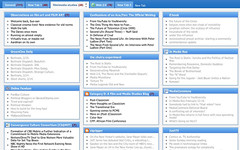
If you set up a netvibes account, you can add this tab and then reconfigure it as you like. This kind of remixing, personalizing, and sharing of modular content is one of the most exciting things about the contemporary web. And yet, many websites are keeping their full RSS feeds from us, making us click over to them to get the full story. Increasingly, I am interpreting this lack of full feed as a kind of arrogance or passive aggression, as though people are saying, "you come to me, I don't feel like coming to you." Increasingly I am avoiding partial-feed websites in favor of full feed ones. I would rather be able to read it the way I want. According to some authorities, blogs that switch to full feeds often get more readers. (I am too lazy to track down where I read that this afternoon, sorry.)
Here are some more newfangled web tools I have recently been playing around with (or contemplating playing around with) and a little bit of scholarly prose to put it all in context:
-Peel, an MP3 blog reader for the Mac.
-Pipes, the new masher-upper from Yahoo!
-OttoBib, an online automated bibliography generator in the citation style of your choice.
-FeedYes, to create an RSS feed for a site that doesn't have an RSS feed.
-"Remix and Remixability" by Lev Manovich.
If you set up a netvibes account, you can add this tab and then reconfigure it as you like. This kind of remixing, personalizing, and sharing of modular content is one of the most exciting things about the contemporary web. And yet, many websites are keeping their full RSS feeds from us, making us click over to them to get the full story. Increasingly, I am interpreting this lack of full feed as a kind of arrogance or passive aggression, as though people are saying, "you come to me, I don't feel like coming to you." Increasingly I am avoiding partial-feed websites in favor of full feed ones. I would rather be able to read it the way I want. According to some authorities, blogs that switch to full feeds often get more readers. (I am too lazy to track down where I read that this afternoon, sorry.)
Here are some more newfangled web tools I have recently been playing around with (or contemplating playing around with) and a little bit of scholarly prose to put it all in context:
-Peel, an MP3 blog reader for the Mac.
-Pipes, the new masher-upper from Yahoo!
-OttoBib, an online automated bibliography generator in the citation style of your choice.
-FeedYes, to create an RSS feed for a site that doesn't have an RSS feed.
-"Remix and Remixability" by Lev Manovich.
Subscribe to:
Posts (Atom)