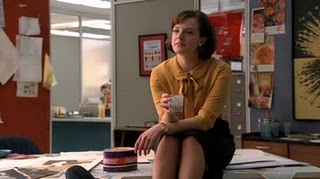
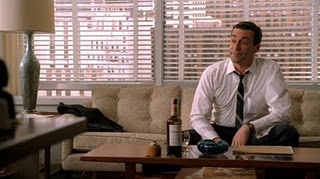
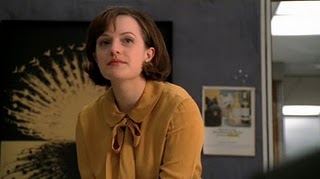
Pete Campbell: I’m going to be a father. His father-in-law: Can you believe it? Mad Men viewers: uh, yeah!
Irony is one of Mad Men's most indispensible storytelling strategies. Irony is at home in many kinds of storytelling, but Quality TV benefits from one of the most essential effects of ironic narration: it requires that we "get it." It exploits the audience's special knowledge and competence, which the text flatters us for having.
Mad Men's irony comes in several varieties. This historical setting provides frequent “we know better now” bits, as in season one’s scene at Sally Draper’s birthday party when a man slaps a boy in the face--not his own child--for running in the house. Pregnant women smoke and drink, babies ride in cars unrestrained, middle-class picnickers litter conspicuously and without hesitation. Sexist and anti-semitic attitudes are simply there, unremarkable, and though Don seems to find Roger Sterling's blackface number in "My Old Kentucky Home" to be rather unpleasant, no one calls Roger out as racist or even seems to find such a display to want in taste. Our superior knowledge gives these bits much of their dramatic weight, allowing us to see the past as a more innocent but also less advanced era and anticipating the changes that made our world. Even our foreknowledge of historical events, like Kennedy's triumph over Nixon in the 1960 election, functions to give us the kind of insider knowledge that is the essence of ironic discourse.
Another form of ironic storytelling similarly depends on the superior knowledge of the audience, but depends on the familiarity of viewers with characters and storylines stretching back through the previous seasons. This is what high school English teachers tell us is "dramatic irony" of the sort we often find in Shakespeare, in which the hierarchies of knowledge set up by the narration invite the audience to view situations from multiple perspectives. It arises frequently in this week's episode in situations in which characters' speech unwittingly comments on their situation, but only to the extent that the audience knows more than the characters.
Ken Cosgrove, to Pete: Look how lucky we are. Another Campbell, that’s just what the world needs.
In this episode, focused especially on Pete Campbell and Peggy Olson, the most devastating ironies are those referencing the ongoing storyline in which Pete impregnates Peggy and she gives the baby up for adoption. Pete remains unaware of this development until late in season 2, when he confesses his feelings for Peggy and she tells him what really happened.
In "The Rejected" (my favorite episode of this season so far) we learn that Trudy Campbell, who we had thought might be infertile, is expecting a baby. This gives the writers all kinds of opportunities to subtly refer back to the Pete and Peggy storyline.
Pete: It feels much different from what I expected. Trudy: How would you know what this feels like?
Eventually they get around to setting up the interaction we are most eager to see: Peggy addressing Pete having heard this news. But first a series of other scenes in which we observe characters who do not know of Pete's earlier paternity respond to the news. Invariably the developments have meaning that resonate with the central thematic preoccupations of the show, those with the power imbalances of gender and class distinctions. Peggy could not have borne Pete's baby openly and also pursued her career. It would have ended her working life, at least for many years. The product of Pete's legitimate parental expectancy, however, is a new $6 million account. He who has so much advantage gains more.
This disparity is made clear in the late scene of Pete and Peggy each going off on their own lunch outing, Pete with his male colleagues and his father-in-law and his business associate from Vick's, the new account, and Peggy with her new hipster friends from Life magazine. This distinction between corporate and creative power is a fine illustration of Bourdieu's distinction between economic and cultural capital, and of the ultimate inevitable subsurvience of the latter to the former.
The storyline around the research for Pond's reinforces the themes of the Pete/Peggy situation. Allison's public breakdown over Don's inattention following their post-Christmas-party tryst gives Peggy the opportunity to deny that her sexuality ever might have gotten in the way of her job prospects, and she berates Allison for assuming that Peggy would sleep with her boss and then find herself unable to get over him. Of course the situation with Pete was quite similar in the first season, and the ultimate repercussions much worse than what we suspect will be the case here. If season 1 Peggy had only had the courage Allison shows in telling Don that he's not a good person!
Peggy, to Allison: Your problem is not my problem. And honestly? You should get over it.
This plot also reintroduces Faye, the married professional market researcher, another model of femininity against which to judge Peggy. Faye's performance in the focus group scene, changing attire to blend in with the secretaries and removing her ring (which Don catches Peggy trying on, delicious moment), shows her adapting her feminine appearance to her situation with great confidence and effectiveness. By contrast, Peggy seems to struggle with the negotiation of gender norms in the workplace.
In relation to the two-way mirror scene of season one, much is now different. In the test group using Belle Jolie lipsticks, Peggy stands out as the one who doesn't want to be one of a hundred lipsticks in a box, and she impresses Freddie Rumsen with her observation that the trash bin containing the spent blotted lipstick tissues is a "basket of kisses." (He likens this turn of events, in which a secretary says something worth using in a sales pitch, to seeing a dog play the piano.) Now Peggy and Joan are on the other side of the glass and in positions of more power and authority, and Freddie complains that he has no office in which they can meet. Of course Peggy, Freddie's protege in earlier days, does have her own office (from which to peek at Don's in the best visual humor of the season so far).
The introduction of Joyce, the hipster lesbian photo editor at Life, offers Peggy an entree into a world antithetical to the corporate milieu of SCDP and Pete's in-laws. The line about Peggy's boyfriend renting her vagina recalls the prostitution trope of "Christmas Comes But Once a Year" and raises the idea of male control over female sexuality and reproduction. Had Peggy shamed Pete into leaving Trudy for her and raising their baby together, this experience would have been totally unavailable to her.
Peggy: Trudy’s pregnant? Joey: I can’t believe that guy’s married to her. I would get her so pregnant.
Peggy and Pete are fated to be paired up for as long as Mad Men tells its story. In "The Rejected," many are rejected -- Joyce's photog friend, Allison, Clearasil, Joyce, Faye (I'm sure there are more). We can't forget as well that Peggy rejected Pete for her career and independence. The parallelism of these characters is reinforced by the two scenes of beating the head, first Pete's against the wall after learning of the Clearasil account, then Peggy's against the desk after learning of Trudy's pregnancy.
Peggy, to Pete: I just wanted to let you know how happy I am for you both.
And in the end they exchange these meaningful glances, which those of us who have been watching all along fill in with all of our accumulated Mad Men knowledge. We see these characters acknowledge one another, wordlessly recognizing all that has gone on between them, showing that they are in on the ironies we have been catching throughout. It's like the show is congratulating us for getting it, but with such subtlety that the forceful emotional impact of this resolution to the episode narrative is totally undiminished.
Mad Men tells its story very slowly and carefully. There are so many more ironic situations pregnant with potential for emotionally charged storytelling. Pete among others still knows about Don's identity, and Don and Pete know about Peggy's pregnancy. In a good serial narrative, the past is never dead or even past.
Sometimes this season I try to imagine myself watching Mad Men as some people I know are doing it, without having seen seasons 1-3. This week’s episode, “The Good News,” might be among the less comprehensible in the whole series, but there would certainly be funny and poignant moments. Don’s man-date with Lane has its outrageous bit of comedy. Joan’s firing of Lane’s secretary for failing to take responsibility for the flowers fuckup is deliciously dramatic. I would gladly watch Don Draper drive a red convertible along the Pacific coast for an hour or two each week. The scene in which Greg stitches up Joan’s finger while telling his hillbilly joke is one of the most arresting in the episode whether or not you know the backstory of these two, though it packs much more of an emotional wallop if you know [SPOILER ALERT!] that (1) he raped her, and (2) he has no brains in his fingers, which has led to (3): he joins the army and is soon shipping off to Vietnam, where he will die.
I said as the scene ended, “I really don’t want to like that guy” and well, that scene made me LOVE him, which is just wrong. Of course I don’t know that he’s going to die. The M.D.s are less likely to die in a war than the G.I.s, but given that these scenes were paired with the ones of Dick finding out about Anna’s terminal illness, death is a theme.
This show makes me want to fish for thematic parallels and obscure allusions, and bear with me. One of the movies Don and Lane consider seeing on New Year’s Eve is The Umbrellas of Cherbourg (IMO, the greatest film ever made) and in that movie, the protagonist played by Catherine Deneuve becomes pregnant with a child just before her lover departs for the war. When he returns he finds her having set up a family in his absence with another man. In “The Good News” Joan is looking to get pregnant at the same time that her husband is shipping off to Vietnam. Uh huh. Another thing this episode makes me think about is harm to people’s legs and feet. First in Season 3 Guy McKendrick is run over by the John Deere driven by Lois, his career ending in that awful bloody moment; then the Ad Age reporter sent to interview Don in “Public Relations” is missing a leg (lost in the war, of course, the same one in which Dick became Don), and now Anna Draper, who already limped from polio, has her leg in a walking cast. I’ll get back to you about the ultimate significance of the deep symbolic meanings involved here but they sure suggest mortality and pain.
We learn a lot in this episode, which I found to be among the most amusing, surreal, and inconsequential of the series so far. Joan has had two abortions, one of them performed under questionable and undoubtedly dangerous circumstances. This threatens her ability to have a child with Greg, though the gyno (he calls her Jojo and she calls him Walter -- interesting!) seems confident enough.
I would predict that Joan can’t have kids, though perhaps an even better storyline for her would follow the Umbrellas situation -- pregnant with an absent husband, or maybe Greg returns from the war with a bum foot? Let’s keep going: Anna Draper is dying and everyone is keeping it a secret from her. This is one of the show's "period" ironies -- in those days, that's how things were done. Can you believe that? As well, Lane, like Don, is divorced. (Remember the scene in “Love Among the Ruins” when the Pryces an Drapers go out for dinner together?) The students at Berkeley are staging sit-ins. A whore cost $25 in mid-1960s NYC. Don Draper will indeed put the moves on every young, attractive woman he comes across. And so on.
If you haven’t watched every episode leading up to this one, you don’t know that scenes in an OBGYN office are always important.
Peggy goes to Joan’s doctor -- the same one we see in this episode -- for birth control in “Smoke Get in Your Eyes” only to meet with his paternalism and disapproval. (“Even in our modern times, easy women don’t find husbands,” he admonishes.) Betty sees hers in season 2 to find out about her surprise pregnancy with baby Gene. Now here we are back with Jojo’s Walter. This is so obviously a “setting things up” episode that Joan’s fertility is undoubtedly in play as S4 progresses, as is Anna Draper’s mortality. I can’t help but anticipate a connection between them.
But what seems most in play is the underlying identity of Don Draper as Dick Whitman. If Anna Draper dies, so does the experience Don/Dick has of being a true, authentic self, a pre-Don Draper innocent. We know that the season’s theme is supposed to be “Who is Don Draper?” This episode pushes us to consider the possibility that Don is no longer the assumed identity of Dick, that enough time and experience has passed that the identity of Don supersedes that of Dick. When Don signs her wall "Dick + Anna '64" it makes it seem as if Don is performing an earlier, more youthful identity rather than, as earlier in the series, as if Don is Dick's performance.
The larger significance of these observations for my ongoing MM blogging project is to see the dense interconnection of themes and motifs, along with the backstory and our memories of characters’ journeys, as essentially legitimating of shows like this one. A network serial would most often belabor the backstory with expository recapping dialogue. Characters would remind one another of their situations. For instance, Joan and Greg’s exquisite home surgery scene would find more obvious ways of reminding us that Greg’s career as a surgeon had seemed so promising, only to fall apart when he was denied the chief residency. Anna and Dick’s moments together would find more obvious ways of reminding us of that earlier episode, “The Mountain King,” when Don first pays her a visit and remembers the earlier time when they were together. The subtlety of this episode’s allusions and cues to memory works in a different register of audience address than the typical mass television fare, rewarding and flattering the completist audience for Quality TV (and especially the people like me who have seen every episode at least twice) and basically showing a lack of interest in pleasing the casual viewer who, presumably, is necessary for guaranteeing the networks their larger audiences. But who knows, maybe those casual viewers -- you know who you are -- get their own kinds of pleasure from watching casually, which I only wish I knew about. I find the show to be a kind of reverse guilty pleasure at this point, pushing me to invest in its symbols and references, its dense thematic interconnection of episodes. I almost wish I could watch it in a state of innocence, just to find out what will happen next.
PS I never thought Don was really going to make it to Acapulco in this episode, and I'm still not sure why they decided to call this one "The Good News."
Prostitution is a recurring presence in Mad Men, both as representation and metaphor. In the very first episode, “Smoke Gets In Your Eyes,” Peggy offers herself to Don by placing her hand on his only to be brusquely cast aside with the line, “I’m not your boyfriend.”
Is part of her paying job to be sexually available? Maybe, but Don’s not interested. It could be because she dresses too modestly for Manhattan in 1959 and seems unsure of herself -- the opposite of the office sexpot, Joan. Now in “Christmas Comes But Once A Year” with Don several secretaries past Peggy at Christmastime 1964, Allison returns Don’s lost keys and must be sexually available to him. Her recompense is a $100 Christmas bonus. He might have given her as much otherwise, we’ll never know. But the unavoidable suggestion is that she is being paid for a service more intimate than typing letters and buying birthday gifts for Sally, Bobby, and baby Gene. We know by her facial expressions when called into his office on the morning after that she is falling for Don (or has fallen for him already) and feels like his lover rather than his whore, which debases them both when it becomes clear that he intends to treat their encounter like his pre-Korea identity and Peggy’s baby -- as something that didn’t happen. (We have prostitution in mind already this season from the previous episode, in which Don sleeps with a whore who knows what he likes -- being slapped around in bed.)
Quality TV like Mad Men rewards the attention of the most serious, committed viewer who watches from the beginning and in order, who never misses an episode, who remembers and appreciates details. This is TV in its aestheticized mode encouraging attention to form and to thematic meaning, soliciting explication and interpretation (I am the victim of this appeal as much as anyone). “Christmas Comes...” works ok as a standalone episode but this kind of show has no standalone episodes. We are especially gratified by the prostitution theme considering our previous encounters with Lee Garner, Jr., the Lucky Strike heir who in the previous season ruined the career of the closeted gay illustrator, Sal, by demanding that Sal be fired after refusing a sexual advance.
In this new episode Garner again demands quid pro quo. Not only must the ad firm throw a Christmas party at which he is given the only significant gift, but Roger Sterling must don the Santa suit and pose for ridiculous photos with the SCDP men posing on his red velvet lap.
There is one more moment of quid pro quo involving sex and power in this episode, but by contrast to these more despicable representations, the story of Peggy’s relationship with Mark is more gentle and affectionate, though I foresee bad times ahead for these two. Peggy says in season one that she tries always to be honest, but she has let her boyfriend think she is a virgin and of course she is hardly that. The previously before this episode reminds us that she slept with Duck Phillips in season 3, and we committed viewers know of other lovers including Pete Campbell. Every sexual situation involving Peggy reminds us that she got pregnant at the beginning of the series and gave away her baby. Now Mark is trying to pressure her to giver herself to him, and in a humorous bit of dialogue he says, “I brought you cookies!” He doesn’t really mean that she should have sex in exchange for cookies, but as ever there are resonances from elsewhere that amplify the meaning of what might have been a throwaway line.
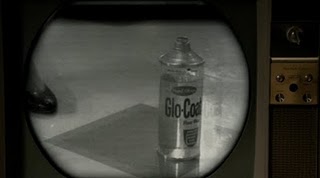
Earlier in the episode the market research people Bert Cooper brings in offer the SCDP folks cookies in exchange for taking a test they administer to collect data about consumers, which Don refuses to take (because it reminds him of his awful childhood and diasterous domestic situation). Later Faye, the self-assured blonde who runs the testing, explains her methods to Don and seems to have him totally figured out, which troubles him. She even infers that his cinematic Glo-Coat ad of the previous episode was a product of his childhood! Along with his neighbor Phoebe, a nurse at St. Vincent’s, Faye seems like a potential new romantic partner for Don (maybe she still is), so it surprises us at the end of the episode when he winds up with his secretary. But of course of all of these women, she is the one over whom Don holds power.
The thematic parallelism of Don’s fling with Allison and SCDP’s submissive deference to Lucky Strike, as well as the bits with the cookies, brings home a meaning familiar from earlier seasons and episodes: that business and personal affairs alike are structured around unequal relations of power. Capitalism and Patriarchy both demand supplication to authority and money. They thrive on inequality. The story of the 60s which Mad Men is so methodically telling is a story of progress toward equality in some spheres. But it’s also a story of our own times, in which consumer capitalism has grown only more rampant, and in which “post-feminism” has obscured many of the persistent and insidious inequalities between and among genders. Prostitution is a metaphor for unequal power relations, for the degradation of the weak by the powerful.
It is also a potent metaphor for the creative process, and in a commercial medium like television as in advertising, the authentic talent of artistic workers is often represented being under threat from the power of capital to pervert and exploit. The creative person whores their talent. Art like love ought to be a gift, but a both are often given with expectations of something else in return. In feminist analyses, heterosexual relations and in particular marriage are sometimes seen as variations on prostitution. Betty is often portrayed as a victim of such unequal relations between married persons before she and Don split up, and in season 2 she flirts with selling her body to the auto mechanic who stops to help her (this is a way of getting back at Don for his affair with Bobbie Barrett). Joan is likewise represented as selling herself to her husband, Greg, who asserts his ownership of her body in the season 2 scene in which he rapes her on the floor of Don’s office. The overarching metaphor of advertising as a big lie, an illusion of authentic reality, also feeds into the recurring prostitution theme. The work Don and Peggy and Sal and the others do, work that has real meaning and comes from a place of real personal inspiration, is sold to the corporations who exploit it for their profit. As I argued last week, this functions not just as a critique of advertising or capitalism, but as a metatextual commentary on the status of the television creator. Being beholden to a powerful master cuts across all the levels of meaning.
***
Peggy does sleep with Mark, but the truth about her virginity is still her secret. Don is an asshole to Allison but we'll see where things go with her. Faye and Phoebe still seem like potential romantic partners, and I doubt we have seen the last of Bethany. And the prostitution theme will undoubtedly persist. At this point, a fourth season of a show that promises to go on several more (I will be disappointed if it ends before 1969), much of the pleasure of Mad Men comes from the repetition with variation, the situations and ideas that come up again and again but tweaked each time to reveal a different shade of meaning or a new twist on a familiar character. I watched some of "Smoke Gets In Your Eyes" earlier to make the framegrab above and was astounded by how much the characters have changed, especially Pete and Peggy, despite the fact that the show continues to tell much the same story.
Quality TV performs its own quality, and Mad Men does this as much as any upscale program. It is constantly, flauntingly reaffirming its own value in so many ways: by dramatizing creative struggles against commercialism; by making itself into an audiovisual history museum; by beaming progressive, liberal ideals through the contrasts it loves to draw between then and now; by investing every detail with thematic meaning, from dialogue to chairs to hairstyles and cocktails (not by accident or genre convention does our anti-hero drink Old Fashioneds). It does so in the by now traditional modernist fashion, being deftly metatextual and intertextual. Quality TV performs its own quality to reassure us that, despite our many and various misgivings about television, we who appreciate it are doing something more than watching soap opera. But what makes so much Quality TV enjoyable is precisely its appeal AS soap opera, the continuing stories of characters we get to know over time, episode by episode and season by season, their larger-than-life conflicts, their fears and dreams, their neverending cycles of relationships and breakups and makeups. Mad Men is about secret identities and hidden pregnancies, rape and infidelity, schemes and counter-schemes. It is about primitive office politics and the fetid suburban reality of self-loathing. We watch to find out what will happen next and how. We watch as communal social practice and ritual, and to have something to talk about when we’re not busy watching. Somehow the geniuses who make this show have sold the boutique cable audience on the fantasy that all of the soap opera we love is legitimated by Quality and its trappings.
Advertising in Mad Men is, among other things, a metaphor for television. Is it Art like the opera in which Bethany Van Nuys is a supernumerary, like the Rothko on Bert Cooper’s office wall, like Frank O’Hara’s Meditations on an Emergency that Dick Whitman mails to Anna Draper? Or is it just a way of selling housewives canned hams and floor cleaners? And can it be both? Keep in mind, last night’s Mad Men was chock full of branded props, like Don’s Canadian Club.
On a second-season commentary, Matt Weiner says he sees himself in both Don and Peggy, mentor and protegee. He identifies with their struggles to produce good work in the face of demanding clients and bosses. There is always the tension between art and commerce in television and advertising, and the authentic is ever the artistic rather than commercial value of “creative” work (remember Don is “head of creative”). Run-of-the-mill TV need not advertise its creative ambitions, but to rise above the status of guilty pleasure, the Mad Men type shows need protection against the inauthenticity of commercialism.
Thus the very contemporary ambition Don voices to make his Glo-Coat spot “indistinguishable from the movies” as a way of holding the audience’s attention and make them forget they are the victims of a pitch. Here we have the cinematization of television so prevalent in contemporary discourses projected backwards thirtyforty-five years.
“Public Relations” also dramatizes the tension between devotion to work and to selling the work, and in order to do so effectively, also the selling of the self as personal brand. Don Draper was taught not to talk about himself but that’s not good public relations. He wants his work to speak for itself. Hard not to see this as the TV creator’s resistance to promotional press, to interviewers asking him to explain himself. Don Draper can always be read as a stand-in for something or someone, and certainly as an ideal of spontaneous creative genius, the kind that cannot be taught. But his successes are only realized when the products he is selling really sell; genius is not its own reward. When he complains about having to do PR for himself and his firm, insisting that his work speaks for him, Bert Cooper, ever the canny businessman, retorts, “Turning creative success into business is your work!” No truer motto will ever be coined for the TV creator.
After a long time away we are dying to know what has happened and how. Season Four begins by announcing its theme in bold, italics, and underline: Who is Don Draper? The show often comments on its own meanings in this way, as season two begins “Let’s twist again like we did last summer,” referring at once to the dancing in season one and to AMC’s scheduling. Who is Don Draper? is not just the new season’s theme -- it is the whole series’, and by now we know a fair bit of the answer. But as a theme for the season this looks a little weak. I would rather, Who is Peggy Olson? More is new about Peggy than her hair. She bosses this new male creative guy Joey around (“I need it in an hour, chop chop Joey”) and drinks neat Jameson whiskey. She has become considerably more assertive and confident, and seems to have a steady boyfriend. Mad Men has always let its female characters fascinate us more than its eponymous males, and this is itself thematically significant considering its style of subtle feminism -- while seeming to be about men, it’s really about gender and its recent American history. I’m more eager to fill in Peggy’s story in the time that has passed between seasons than any other character’s.
So many questions are in my mind as I think about the episodes to come. Who will Don sleep with this season? Will things go as badly for Betty and Henry as this episode suggests? Does Kiernan Shipka’s addition to the main credits mean, as we must hope, that Sally Draper will become even more significant? Will we be seeing Paul Kinsey, Ken Cosgrove, Sal Romano, and other departed Sterling Coo characters again? Will the men stop wearing hats? And what new (or old) ways will the show find to legitimize itself?
If you have an interest in cultural media history, if you like Sesame Street and music videos, or if you have found the recent discussions about whether the internet makes you stupid or smart to be worth your scarce attention, you might be interested in my newly published work: “New Media, Young Audiences, and Discourses of Attention: From Sesame Street to ‘Snack Culture’” Media Culture & Society 32.4 (July 2010), 582-596. In this essay I trace the history of the “attention span” as it pertains to media from the early days of Sesame Street to the present, charting the process whereby media crafted to suit short attention spans of the young came to be blamed for shrinking the collective attention span of whole generations and societies. The main materials I studied are popular press discourses, like discussions in the New York Times and Time magazine. I’m generally critical/skeptical of claims that media are a danger to the young and that movies, TV, and the internet do us cognitive harm, though my main concern is to analyze discourses rather than pass judgement. Ultimately I argue that concerns over media’s harmful effects reveal widely shared anxieties over new media’s social implications. If like me you don’t have free access to Sage journals and don't want to wait for your hardworking ILL people to catch up with the speed of academic publishing, please email me mznewman37/gmail and I’ll happily send you a pdf. Happy reading!
I presented the following at the Console-ing Passions conference at the University of Oregon in Eugene on April 24 as part of a panel called Distinguishing Television: Television Genres and Cultural Value.
Despite frequent declarations of the death of TV comedy and the absence of “Blockbuster TV” sitcoms in recent Nielsen ratings, the past decade has seen a new movement in the American sit-com that has found many champions.Comedies such as Scrubs, Arrested Development, Curb Your Enthusiasm, The Office, 30 Rock, and Modern Family have explored forms of audiovisual style and storytelling rarely seen in American TV comedy before the year 2000.These are usually called single-camera shows for short to contrast them against the multiple-camera format of traditional sit-coms.Although rarely big hits, these shows win awards and accolades, appeal as Cult or Quality TV to upscale audiences, and have found some enthusiastic viewers in popular press critics like Time magazine’s James Poniewozik who admire them for being “more ambitious” than traditional comedies and television scholars who praise them for “reinvigorating the sitcom format” (Thompson, 63) or for “resurrecting” the genre through their “stylistic innovation” (Butler, 19).In discourses of television criticism both popular and scholarly, the style of these new programs is positioned as an upgrade on a lowly and exhausted formula -- as a welcome improvement to a genre often denigrated as unoriginal and inartistic.
I want to talk today about this idea of upgrading the situation comedy in terms of television historiography, and in particular in terms of our understanding of the history of television aesthetics.The upgrading I have described is part of a wider process of discursive legitimation of television which positions some forms of TV as more respectable than others, and contrasts putatively more aesthetically advanced contemporary TV against shows of the past.The idea that single-camera comedies are an improvement on the traditional sit-com rests on some questionable assumptions about television history and aesthetics, which I wish to interrogate.Most importantly, I want to insist that if TV scholars are to turn to questions of aesthetics (which I think is a really good idea!), we do so in a way that appreciates all of television history in aesthetic terms rather than just the most recent Quality TV that appeals to folks like us, and that we do so in a manner attentive to the cultural functions of aesthetic discourses.
I’m assuming this audience is pretty clear on what I mean by single-camera and multiple-camera shows, but just to be sure here’s a quick comparison.The traditional sit-com like All in the Family is shot on a three-wall set in front of an audible studio audience -- a production style Jeremy Butler calls the “multiple-camera proscenium schema,” which comedies share with soap opera, another genre with radio origins.
This format allows for the main stylistic emphasis to be placed on verbal and physical comedy, and on the comedians’ performance.Single-camera shows, by contrast, have no invisible “fourth wall” and no audible live audience (or laugh track).They use camerawork and editing much more prominently than multi-cam shows, often as sources of humor, as in punch-in flashback or fantasy shots (think “Werewolf Bar Mitzvah”).They are filmed "like a movie," allowing the camera to penetrate the space of the scene and to shoot from any angle.And as an alternative to the laugh track, many of them use music to punctuate scenes and set a comical tone, or in cases of comedy veritélike The Office, awkward silences (Mills 2004, Thompson).
The contrast between multi- and single-cam styles in popular and critical discourse is often quite explicitly framed in terms of value and aesthetics: the newer style is positioned as an advance, and as a marker of television’s newfound artistic and cultural legitimacy.The old style is figured as primitive and unchanging, a relic of an earlier era of TV as mass medium but not as art.Specific characteristics of the old style like verbal setup-punchline/one-liner humor, dramatic entrances and exits, comedic performance style regarded as excessive, and the laugh track now might come off as corny or passé, good today mainly as something to laugh or sneer at – as an example of this attitude, consider the critical reception of The Return of Jezebel James (Newman).Advanced taste has shifted away from traditional forms of TV comedy.Thus the valuation of single-cam style depends on a historical progress narrative, a way of seeing TV history as leading up toward a more perfect present against which we can judge the failures of the past.This is often how histories of the arts proceed especially in the modern era, by figuring the new as a reaction to and improvement on the old.But TV scholars especially must be wary of hastily recognizing present-day Quality TV as the medium’s height of achievement without considering how aesthetic judgment and valuation function culturally to reaffirm social distinctions, especially those of class.The multi-cam shows with their historical mass appeal are the negative example against which the new single-cam shows with their upscale niche audiences are understood.Additionally, we must be wary of assuming that we can understand the historical significance of the present.Often the celebration of recent and contemporary TV aesthetics risks promoting the current shows, their audiences, and the industry’s strategies of marketing to them, rather than advancing a serious historical understanding of the medium and its forms and functions.
This presentist discourse of the newfound sophistication of television comedy ignores the place of the sit-com in the history of Quality TV.Today the paradigm of Quality is heavily serialized drama shot in a style often called “cinematic.”The single-camera comedy has arisen to its place of high status in the context of this reigning paradigm, and it is no coincidence that single-cam comedies share many traits with the legitimated dramas – not only production norms but also storytelling practices, as comedies also have become more serialized.But we must not forget that in earlier periods of TV history, the traditional multi-camera sitcom was central to conceptions of Quality.In the 1970s, when MTM and Tandem were the production studios most closely identified with programming of high cultural value, The Mary Tyler Moore Show and All in the Family were among the medium’s most respectable programs.In the 1980s and 90s and early 2000s, NBC’s must-see TV lineup combined serialized dramas like Hill Street Blues and ER with traditional sit-coms like Cheers, The Cosby Show and Friends. Praise for the stylistic innovations of the single-camera sit-com often implicitly – or even explicitly – slights the value of the multi-cam show as such without regard to the aesthetic achievements – and cultural significance – of these earlier shows.In celebrations of the new sit-com, the style of old multi-cam shows is sometimes described as an impoverished antistyle (Caldwell), but the positive aesthetic appeals of these shows are generally ignored.
The discourse of the sit-com's reinvention presents a “before” and “after” of TV comedy, and I argue that the “before” is figured as a primitive form.In art history, primitivism is often identified as naïve, unsophisticated, and lacking tradition or stylistic development; the artistic movements that come after primitive stages are generally seen as bringing welcome innovation and advance, i.e., progress (Errington).In the case of TV comedy, the primitive multi-cam style is not only figured as banal and artless, but as having no significant stylistic history.This meshes with the idea that network-era television can be characterized as “least objectionable programming,” essentially unremarkable and aesthetically degraded, a characterization attributed to TV network executives from decades ago which some contemporary TV scholars still find acceptable (e.g., Lotz).The multi-cam shows are seen in the discourse of aesthetic progress as more or less homogeneous, the better to distinguish the new single-cam style.But this presentist celebration overlooks the diversity of the history of American television comedy and paints all sitcoms in the “old style” with a single brush to emphasize their uniformity.
Consider the variety among these shows, all of which are sitcoms predating the rise of the single-cam: The Many Loves of Dobie Gillis, The Andy Griffith Show, All in the Family, Bewitched, The Dick Van Dyke Show, M*A*S*H, Soap, Cheers, The Wonder Years, and Friends. Andy Griffith and Dick Van Dykeare black and white, but later shows are in color.Many of these shows were shot on film to give a polished look of high production values, while others such as All in the Familywere videotaped to produce an effect of immediacy and liveness.Not all were shot in front of a live studio audience; some, like Bewitched, relied on special effects that could not be accomplished with typical live studio audience setups.Not all have laugh tracks; Dobie Gillis and The Wonder Years have voice-over narration.Not all are shot with the “three-headed monster” originated by Karl Freund for I Love Lucy; Andy Griffith and M*A*S*H were shot single-cam, and M*A*S*H aired without a laugh track in some countries.Not all multi-cam shows were shot with three cameras; Cheers and most multi-cam shows since the early 80s have been shot with four, an innovation of James Burrows beginning with Taxi which allows for larger ensembles, more expansive sets, and arguably more fluid editing.The traditional sit-com’s storytelling is quintessentially episodic, with every episode beginning as though the narrative has been fully reset and characters having no memory of previous events.But some traditional multi-cam sitcoms do have some serial aspects to their storytelling, like the relationship arcs on Friends.Of today’s multi-cam shows, not all are uniform in style either.As Christine Becker has written, How I Met Your Mother is shot with multiple cameras on a three-wall set, but without a live audience, a choice she argues makes for a more restrained performance style in contrast to shows that film before an audience.The point is that multi-cam shows are hardly uniform and static in style, but themselves have a stylistic history continuing through the present time.
I want now to go into more detail in considering the way that scholarly discussion of the new sit-com frames the new style in relation to the old style, and the implications of the terms this scholarship adopts for addressing TV style.In particular I’m talking about Jeremy Butler’s Television Style, which relies extensively on two sources for ideas about visual representation: David Bordwell’s work on film form and style, and John Caldwell’s Televisuality.
Much of Butler’s book is concerned with understanding how TV style in recent years has been become more prominent and aggressive, similar to the style of contemporary Hollywood movies that Bordwell calls intensified continuity, which is characterized by fast and aggressive editing, incessant camera movement, and shooting with very long and very short lenses. In some respects, this use of prominent visuals meshes with John Caldwell’s concept of televisuality to describe TV since the 1980s, which Caldwell terms “excessive” and “exhibitionistic.”Butler also borrows a term of Caldwell’s to describe the style of pre-televisuality/intensified continuity movies and TV: “zero-degree” style.Zero-degree denotes a lack of style – Caldwell defines it using the words “empty” and “meager” – or at least a style that isn’t noticeable or interesting.Critics of classical Hollywood cinema often describe its visual style as invisible or transparent, the better to focus the audience on the realism of the diegesis.(In Bordwell’s terms, “zero-degree” is roughly the same as “classical continuity,” though in The Classical Hollywood Cinema he rejects the term “zero-degree.”)In Butler’s argument, the multi-cam sit-com is the zero-degree sit-com, and the single-cam sit-com is the televisual sit-com. Butler celebrates the televisuality of the contemporary single-cam sitcom and even confesses that it brings him “pure aesthetic pleasure.” (216)“In the televisual schema, style is aggressive, roughened, and opaque, not smooth and transparent.It carries meaning.It makes jokes.It might call attention to itself.” (197)Butler discusses many aspects of Scrubs to offer evidence of this, including the show’s staging, shooting, editing, and use of sound.
I see two shortcomings here in the discussion of the style of the multi-cam sit-com in particular, as well as several additional issues of concern.First, both Caldwell and Butler adopt a Bordwellian, film-centered conception of style.They take for granted that style means those things that film or video can do that are unique to -- or at least distinctive of -- them as a medium.In Bordwell’s terms, these include editing, mise en scene, cinematography, and sound, though in the history of film criticism camerawork and editing have often been especially privileged as they are in Caldwell and Butler.This idea of audiovisual style has origins in classical film theory (writers like Arnheim, Bazin, and the Soviets of the revolutionary period), which was often concerned above all with defending the status of cinema as an art form and, thus, with finding those aspects of cinema that are essentially cinematic.Literary or theatrical techniques to be found in cinema, such as dialogue, are hard to defend as “cinematic” style, and have little place in the history of film theory and stylistics.So this idea of what “television style” consists of essentially takes the prevailing conception of film style, which is a product of cinematic medium essentialism, and imposes it on TV.
Second, those who promote the single-cam shows at the expense of the multi-cam shows fail to recognize the positive style of a theatrical genre like the traditional sit-com.While the camerawork, editing, and lighting of a multi-cam show might be unremarkable, they serve effectively to support the elements of style that are emphasized: writing and performance.As Brett Mills argues, the sit-com is among the TV genres most identified with live performance on the stage (Mills 2005). Instead of regarding this as “lacking style,” we can see it rather as having a theatrical rather than cinematic style (without intending these terms to essentialize either cinema or theater -- I mean that their styles share some significant elements with prominent uses of cinema and theater).The contemporary ideal of Quality TV is thoroughly cinematized – good television is supposed to look and feel like a contemporary Hollywood movie, or even to surpass it.An ideal of television art that makes theater values more significant than cinema values seems today hopelessly out of date.And yet an aesthetic appreciation of television that is not ahistorical should be sensitive to the significance of shifting tastes over time.An All in the Family episode was meant to come off like a one-act play, and was staged and performed as such.The idea of television recording a performance, rather than using camerawork or editing as performance, is not naturally stylistically impoverished as Caldwell and Butler suggest.Rather, it follows from a different conception of style and its uses.
This scene from season 2, episode 15 of Cheers ("Father Knows Last," orig. aired January 20, 1983)is typical of the power of the traditional sit-com's style. It begins as so many traditional sit-coms of its period did with the reminder that the show was filmed before a live audience, marking its style as theatrical. Camerawork and editing are fluid and emphasize reactions, as well as contrast between the confidence of the women and the cowardice of the men. In terms of cinematography and editing, there is little difference between this kind of style and that of numerous Hollywood films of the studio era. But we might say the dominant stylistic features are in the script and the actors' performances. The editing and camera styles serve to support the verbal humor, such as Cliff's reference to women as "petunias" and his remark that they are "hot for" him and Norm, and the bit about talking out of the side of your mouth. The comical value of the scene comes from the actors' styles of dialogue delivery and movement, as when Cliff and Norm saunter over to the end of the bar and back trying to appear nonchalant, and especially in the comical high point of the scene as they stand helpless in the face of the invitation to go out with the women, unable even to utter a word as Cliff vocalizes his terror.I confess to my own aesthetic pleasure when I watch shows like this, which delight me easily as much as the best single-cam shows. The images and sounds in a show like Cheers are not best considered as an antistyle or impoverished style.They may not be “televisuality” or intensified continuity or comedy verité, yet they are part of a robust and enduring tradition of comedy on television.
As Amanda, Annie, and Melissa have blogged, there was a robust twitter "backchannel" at this year's CP conference on TV, feminism, etc., and this produced some beneficial and some not so beneficial effects. I composed most of these thoughts, some in my head and some on "paper," before reading their intelligent remarks, and those in their comments too. But I wanted to share this anyway because I do think some of my ideas are fresh even if others are a bit redundant with what's already being said. I feel strongly that twitter is adding greatly to academic discourse, and that this has been a pretty egalitarian phenomenon. I love it that I am getting to know more people this way than I did before, and that many of them are graduate students, some of whom I was pleased to meet for the first time this weekend. I don't want to come off sounding too cranky about it, but a few aspects of conference twittering in this day and age seem like they could use improvement, which is what you would expect from any emergent phenomenon. So in reference to Annie's post in particular, I would really hate if any of the criticism of twitter were to have the effect of scaring off anyone from participating.
Of approximately 130 conference participants, maybe around two dozen posted tweets during the proceedings in Eugene (others contributed from afar), and a smaller number produced large volumes of "live-tweeting," i.e., moment-by-moment reporting from the panels. I was especially impressed with the volume and quality of live-tweeting produced by @annehelen and @l_e_s, as well as @castabile, @princesscowboy and others. The benefits of this work are apparent to anyone who has trouble being in two places at once. You can hear about panel B which you skippd in favor of panel C, and can keep up witn the conference from afar if you can't make it in person. At first when my twitterfriends started doing this it looked liked way too much unwelcome information (If I wanted to know what was going on at NCA, I would have gone to NCA godammit!), but I have come to appreciate the value of having these real-time missives from the conference. Among other things, it establishes a community of interest that's more specific than the conference community, and that extends beyond the conference to others looking in from afar. And it preserves the conference, capturing the ephemeral live presentation and archiving it online. In this last sense, the backchannel functions to keep the minutes of the conference as it happens.
Much as I like it, however, and despite some attempts, I have not found that I care to do this kind of conference twittering myself. I don't like typing on a compact device like an iPod and don't like lugging a heavy MacBook around with me if it's not necessary. Worse for me and more important, I am a terrible multitasker. If I start crafting a tweet while a presentation is underway, I will have to tune out of some of the presentation to get my thoughts straight and make sure I have spelled and phrased things correctly. (To quote a tweet by @melodyisazombie, "what is the consensus on tweeting and still remaining an active listener? i cannot do both, personally.") I suppose I could become more casual about it, but this really isn't my nature. Someone said you can think of it like taking notes, but at least I make a distinction between taking notes for myself and taking notes in public. To do the latter, I have to turn on my internal censor, and it takes too much cognitive energy to keep him satisfied. (The same is true for me, by the way, while watching TV: I can't tweet while watching without stopping watching.)
Another reason I have avoided too much conference twittering is that I like the honest, raw immediacy of response in the instant, but many of the things I am thinking during a conference presentation are admittedly snarky or crabby, and I don't want to show this side of myself to the world. I still have the mind of a graduate seminar participant, eager to poke holes in every argument. But I don't think real-time, public hole-poking online is a good way to build scholarly community. I also fixate on presentation style, like when people read papers without looking up at the audience, or show slides in a room with bright lights that make them hard to see, or mispronounce words or over-rely on cliches. I certainly don't want to read tweets that pick on these things. And I also find myself given over to the occasional wild enthusiasm. I heard one paper at the conference I liked so much I wanted to tweet, This is the best paper at this conference! It probably wasn't that good.
I also have some questions about the ethics of this practice. The backchannel is conducting a fairly robust and critical discussion as the conference panel is unfolding. It concerns me that the people giving the papers might be unaware of this. They may be unaware that people are live-tweeting the conference at all. They are also likely unaware of what is being posted in real time, as it might come off as impolite to be sitting on a panel keeping tabs on the internet (maybe this etiquette will change?). I'm concerned about the practice of giving feedback to presenters who are unable to receive it, and are probably not aware of it being given. Moreover, a significant fraction of the people in the room might be unaware of this conversation going on, and it seems possibly a bit disrespectful to them to be engaging in questioning and commentary without their knowledge. Many of them, indeed, probably think it's a odd idea for people to be using twitter during the conference. Many non-users have somewhat hostile attitudes toward these new media platforms. I agree with Amanda's proposal that the existence of the backchannel be made more evident to all conference participants.
Another ethical issue that I see is the reliability of the the twitter format for summarizing conference papers. Many tweets are admirably accurate and pithy, briefly getting to the heart of the matter. But they can also be superficial or fragmentary. If you're not physically present and you get only the twitter version, you can easily form impressions that are different from the meanings intended by speakers. This happened to me a lot as a participant from afar during SCMS, when I would read the statements tweeted from the conference and wonder how, without the context of the full paper, I could really understand assertions that sometimes struck me as off or just incomplete. (I said as much in my comment to Jason's post on his SCMS presentation.) After the first two days of massive CP tweeting, I went back and combed through my paper to try to eliminate any phrase that I thought might make me look bad if decontextualized in a tweet. It's good if being tweeted makes us speak with greater clarity and persuasiveness. But mixed with a bit of disappointment that no one tweeted from our panel was a bit of relief.
Which brings me to another matter: those doing the twittering are the ones to determine which parts of the conference are covered by twitter. Some panels were attended by many of the twitterati. This gave the false impression, for instance, that the conference was dominated by discussions of Mad Men. At the same time, there were a number of panels that were covered little or not at all by the twitterati, thus giving no sense of their contents to the world outside the conference, and no archival presence online. My own panel was on Distinguishing Television, with Elana Levine, Phillip Sewell, and Caryn Murphy. I thought it went really well but as far as the backchannel is concerned it never happened. I noticed this especially at SCMS this year -- the TV and new media scholars seemed much more interested in conference twittering, and the majority of the conference, which is devoted to film studies, was largely unrepresented. If conferences are to be documented this way, it might make sense to organize the documentation to cover the whole of the proceedings. But conference twittering is not really organized, and this is part of what is exciting and fresh about it. I'm not sure institutionalizing conference twittering will preserve the things we like about it.
I see an easy solution to some of these problems, and it's not very novel. Make it a convention of conference presentations that all work is posted to the internet in full and made accessible to anyone simultaneous with the presentation. This way the live-tweeters will be relieved of the more secretarial dimension of their work, the better to engage on the level of questions and replies. And this way the partial understandings and misunderstandings can be minimized. This shifts the model of conferencing from presenting to presenting-plus-publishing, but it could serve to promote higher quality presentations (because they have to be in a publishable written form to be presented), or even better to limit the time spent reading papers and maximize the time spent engaging in scholarly exchange, and also to better archive the contents of a conference. Many scholars already publish conference papers on sites like Scribd and on blogs. But if conferences can centralize the publishing on their web spaces this makes things easier and more logical for many participants.
Conference tweeting might be most salutary and effective in revealing a need to make all of the knowledge produced at conferences available beyond the four walls of the presentation room. Here's hoping this happens soon and in a way that expands our open access to all scholarly work.
In the fall 2010 semester I will be teaching a graduate seminar, and I wanted to use this space to share some of my thoughts and plans.
Some context: I get to teach graduate seminars only once every two years, which doesn't seem like all that often. I like the idea of matching the topic to my current research interests, which explains why I'm not going to repeat the seminar I taught last time on indie culture (which I thought went pretty well). I'm still interested in indie culture, but I have been looking at new areas of study. I see the opportunity to teach graduate students as an occasion to read work that I want to know better. Some of it might be material I have read before but not studied carefully, and some of it will be new to me as it will be to everyone else in the seminar.
Elana and I have been working on a project on convergence-era television and cultural status, and this research has piqued an interest in the history of media technologies. So much of what is interesting about TV in recent decades is a product, in part, of the integration of digital TV technologies. Thinking about the intersection of television's contemporary social and technological identities has made me want to know more about the history of communication technologies, and to think about new media (in the current sense of digital media) in light of this history.
I am posting this here for a few reasons. Most importantly I want prospective seminar participants to have a sense of what they are signing up for. This will be a reading-intensive course with a fair bit of time spent on the past rather than the present of new media. I also wanted to pull the curtain back a bit to reveal the process of developing a course. When I was a student I would have been happy to learn more about instructors' thinking behind teaching certain topics and shaping a syllabus. And I am also eager to invite your feedback, whether in the comments or elsewhere, to help me find the right shape for a course on a topic, New Media, that always threatens to get out of hand. I'm happy to hear from students past and future, as well as others who have taught or studied these topics. Feel free to suggest more readings, to let me know about your experiences teaching this material, or to warn me off of spending a week on Marshall McLuhan.
Some of the work I have in mind to consider in this course will fit into the typical conception of new media studies. Benkler and Lessig are clear instances of scholars engaged with questions about changes brought on by digital communications. But some of the work I want to look at is much older, and considers media which are no longer new in terms of what changes they wrought on society and culture. I'm not sure how much of the material that interests me will fit into the course. I don't know if work on oral vs written cultures will make the cut and I don't know if spending too much time on telegraphy and telephony will unduly tax the patience of media studies MA candidates who are probably more interested in today's internet than the Victorian internet. But these are all topics I want to know more about.
Below are some likely and possible readings. The ones I'm especially eager to include in the course are marked with a *. In the past one assignment I have given in a course like this is a book review, where students in groups of between three and five all read the same book. We then have one seminar meeting that's a kind of book club, where we have panel discussions of each book. The items I'm considering for this assignment are marked with a #. Of course there is much more here than one can teach in a single semester, so much of the work below won't make the cut. And because I'm interested in TV first of all, that is the medium that will likely get the most time during the semester. Charles Acland, ed., Residual Media (Minnesota, 2007). *Yochai Benkler, The Wealth of Networks: How Social Production Transforms Markets and Freedom (Yale, 2007) / Clay Shirky, Here Comes Everybody (Penguin, 2009).
Walter Benjamin, "The Work of Art in the Age of Mechanical Reproduction."
*William Boddy, New Media and the Popular Imagination:Launching Radio, Television, and Digital Media in the United States (Oxford, 2004).
Jay David Bolter and Richard Grusin, Remediation: Understanding New Media (MIT, 2000). #Jean Burgess and Joshua Green, YouTube: Online Video and Participatory Culture (Polity, 2009). James W. Carey, Communication as Culture: Essays on Media and Society (New York: Routledge, 1992), or possibly just Chapter 8, "Technology as Ideology: The Case of the Telegraph."
Susan J. Douglas, Inventing American Broadcasting, 1899-1922 (Johns Hopkins, 1989).
Claude Fischer, America Calling: A social history of the telephone to 1940 (California, 1994). Robert Friedel, A Culture of Improvement: Technology and the Western Millennium (MIT, 2007).
Lisa Gitelman and Geoffrey B. Pingree, New Media 1740-1915 (MIT, 2003).
Lisa Gitelman, Always Already New: Media, History and the Data of Culture (MIT, 2008). Henry Jenkins and David Thorburn, eds., Rethinking Media Change (MIT, 2004). #Mark Katz, Capturing Sound: How Technology Has Changed Music (California, 2004).
*Derek Kompare, "Publishing Flow: DVD Box Sets and the Reconception of Television," Television & New Media7.4 (2006), 335-360.
Lawrence Lessig, Remix Culture: Making Art and Commerce Thrive in the Hybrid Economy (Penguin, 2008) / Lawrence Lessig, Free Culture: The Nature and Future of Creativity (Penguin, 2005). #Amanda Lotz, The Television Will Be Revolutionized (NYU, 2007). *The Essential McLuhan (Basic, 1996). *Michèle Martin, "The Culture of the Telephone," in Patrick D. Hopkins (ed.), Sex/Machine: Readings in Culture, Gender and Technology (Bloomington: Indiana UP, 1989), 50-74.
Carolyn Marvin, When Old Technologies Were New: Thinking About Electric Communication in the Late Nineteenth Century (Oxford, 1990).
Nick Montfort and Ian Bogost, Racing the Beam: The Atari Video Computer System (Cambridge, MA: MIT P, 2009).
Walter J. Ong, Orality and Literacy, 2nd ed. (Routledge, 2002).
*Benjamin Peters, "And lead us not into thinking the new is new: a bibliographic case for new media history" New Media & Society 11 (2009), 13-30. #Scott Rosenberg, Say Everything: How Blogging Began, What It's Becoming, and Why It Matters (Crown, 2009). *Lynn Spigel, Make Way for TV: Television and the Family Ideal in Postwar America (Chicago, 1992).
Lynn Spigel and Jan Olsson, eds.,Television After TV: Essays on a Medium in Transition (Duke, 2005).
Tom Standage, The Victorian Internet (New York: Berkeley, 1998).
Jonathan Sterne, The Audible Past: Cultural Origins of Sound Reproduction (Durham, NC: Duke UP, 2003). #Chuck Tryon, Reinventing Cinema: Movies in the Age of Media Convergence (Rutgers, 2009).
Noah Wardrip-Fruin, The New Media Reader (MIT, 2004). *Raymond Williams, Television: Technology and Cultural Form (Routledge, 2003).