A couple of years ago I wrote a PhD dissertation at the University of Wisconsin-Madison called Characterization in American Independent Cinema. In it, I argued that characterization in cinema is a process of social cognition, much like our ordinary process of making sense of others in our everyday lives, and further applied this approach to thinking about characterization to an analysis of how indie films make character a central appeal of their storytelling. I'm now in the middle of turning this into a book. In the process, I am losing much of the theoretical discussions of characterization and adding some new parts about independent cinema's forms, institutions, and culture. I hope to make the cognitivist characterization portions into another book someday that is broader than just indie cinema (and broader than just cinema, for that matter), after I get the chance to do more systematic research into issues in social psychology that I still need to know more about. I decided to focus more on the indie stuff now mainly because it seemed that way more people are interested in it, and it excites me more to write a book that people want to read.
Occasionally people ask me to send them chapters of the diss, and I thought it might be a good idea to publish it on the internet, especially since the more theoretical portions aren't going to see the light of day in any other form in the near future. So I have uploaded the chapters to Scribd. Here are links, with brief additional info:
Title page
Chapter 1: Introduction (Headings: pg. 1 Independent Cinema and Character; pg. 4 Character, Person, and Self; pg. 17 A Cognitive Theory of Characterization: Intuitive and Counterintuitive; pg. 21 Character and Characterization; pg. 27 What About Subjective Narration?; pg. 34 Making Sense of American Independent Cinema [I would start reading here if you're into indie cinema but not so much into cognitive film theory]; pg 36 Auteurs, Spririts, etc.; pg. 39 Hollywood/ Off-Hollywood, Art Cinema/Independent Cinema; pg. 43 Viewing Strategies; pg. 66 Conclusion.)
Chapter 2: Typing (This chapter is about how we categorize characters into myriad types; Headings: pg. 77 Traits and Types; pg. 85 Stereotypes; pg. 93 Social and Genre Types; pg. 99 Typing in Process: Passion Fish; pg. 112 Conclusion. Some of the ideas in this chapter turn up again in an article I wrote for a special issue of Film Criticism on complex narratives, "Character and Complexity in American Independent cinema: Passion Fish and 21 Grams" [pdf].)
Chapter 3: Mindreading (This chapter is about how we predict and explain the behavior of characters by inferring mental states such as beliefs and desires--some experts call this mindreading. Headings: pg. 116 Mindreading: Character Psychology Inferences and Judgments; pg. 121 Folk Psychology; pg. 135 Causal Attribution; pg. 151 Heuristics of Social Judgment; pg. 157 Conclusion: Mindreading in American Independent Cinema.)
Chapter 4: Emotion Expressions (This one begins with a quotation from Fritz Lang that I really like, which reads in part, "Film has revealed to us the human face with unexampled clarity in its tragic as well as grotesque, threatening as well as blessed expression." Headings: pg. 163 Character Emotions; pg. 164 The Face; pg. 169 The Voice; pg. 172 Emotion Expressions: A Closer Look; pg. 176 Problems in Expression Recognition; pg. 182 Emotion Expressions in Film; pg. 186 Facial Expressions in the Construction of Character: Welcome to the Dollhouse and Hard Eight; pg. 196 Conclusion: Combining Appeals. Some of the ideas in this chapter, along with some of the preceding one, found their way into an article in Film Studies: An International Review, "Characterization as Social Cognition in Welcome to the Dollhouse" [pdf].)
Chapter 5: Characterization in Style (I argue in this chapter, among other things, that all audiovisual technique in a narrative film can be understood to have a characterizing function. I doubt that my advisor really buys this idea but he never put up a fuss about it. Headings: pg. 203 The Challenge of Style; pg. 204 Style and Character in History; pg. 212 Characterizing in Style: Story and Self; pg. 226 Levels of Characterization in Style; pg. 242 Style and Character in Todd Haynes' Safe; pg. 260 Conclusion.)
Chapter 6: Infinite Variety: Variables of Characterization (In this chapter I offer a typology of characterization variables along three axes, depth, complexity,and change. I argue, counterintuitively, that independent cinema characters or characterizations are often shallow rather than deep, straightforward rather than complex, and static rather than changing. One way of creating interesting characters is by keeping the audience at a distance from them, forbidding us access to their psychology, and refusing to have them follow the typical Hollywood hero's trajectory toward self-knowledge and revelation. Headings: pg. 268 Round and Flat; pg. 274 Narration and Characterization; pg. 277 Variable 1: Depth; pg. 294 Variable 2: Complexity; pg. 310 Variable 3: Change; pg. 324 Conclusion.)
Conclusion

5/07/2007
Lauren Graham talks to TV Guide's Michael Ausiello about deciding to end Gilmore Girls. If you love the show, prepare to shed tears. She talks about her mixed feelings about this season, about the loss of Amy Sherman-Palladino from the creative team, about romantic-triangle storytelling, and about her feelings about cast members. She's very candid, very Lauren Graham.
Meanwhile, we will soon know more about next fall's schedule. If you just can't wait for it, see Deadline Hollywood's scoop-y, dish-y prime-time pilot handicapping. (No mention there of The Return of Jezebel James--is it for midseason?)
Meanwhile, we will soon know more about next fall's schedule. If you just can't wait for it, see Deadline Hollywood's scoop-y, dish-y prime-time pilot handicapping. (No mention there of The Return of Jezebel James--is it for midseason?)
5/06/2007
Irony, Sincerity, and Fountains of Wayne
In the video for "Someone to Love," the first single from Fountains of Wayne's new album Traffic and Weather, the tropes of early MTV are reheated with that mix of affectionate nostalgia and gentle mockery that has come to define so much of contemporary culture as it re-circulates the images, sounds, and narratives of the past. The video for "Someone to Love" tells a story about a boy and a girl--exactly the story told by the lyrics. When Fountains sing of a woman spending an hour in the shower or a man working as a lawyer, that's exactly what we get. For the choruses the band lipsyncs on a television in a character's apartment against stylized colored lights, and that's about as cheesy a device as you'll find in music video. Like the band's only real hit, "Stacy's Mom," the video for this new song tries to play to two audiences: young people with no memory of the first crop of MTV videos, for whom the text plays straight, and aging hipsters of the band's vintage who get that they're a stylish, knowing knockoff of the early 80s new wave pop sound and recognize the slight goofiness of these video homages--especially the excessive Lolita-meets-Fast Times iconography of "Stacy's Mom." In an interview about "Stacy's Mom," Schlesinger talks about the very specific early 80s sounds they're after, including Rick Springfield and The Cars. He even calls it ripping off, though he obviously means that in the nicest possible way.
Fountains of Wayne's music is a perfect blend of sincerity and sendup, with moments of honest pathos passing imperceptibly into revival style that goes a bit too far. On the new album, the rhythm guitar over the percussive piano line of "Yolanda Hayes" is straight out of a Joe Jackson intro ca. Stepping Out, while the panting vocals over a sexy bouncing synth line in "Someone to Love" might segue any second into "You Spin Me Round (Like a Record)" (...baby right round round round). Adam Schlesinger is an ace at dreaming up songs that make you smile even as you cringe a little, as he has done in composing for films like That Thing You Do! and Music and Lyrics. The whine of Chris Collingwood's voice works well with Schlesinger's sad sack suburban themes in songs for Fountains of Wayne. The lead characters in "Someone to Love" are lonely twentysomething New Yorkers who need each other but fail to connect. The narrator of the wistful "Hackensack," off the band's previous effort, Welcome Interstate Managers, pines for a high school classmate who became successful in showbiz while he remained stuck in his hometown working for his dad. I'm sure Schlesinger doesn't mean to be putting anybody down, but his portraits of post-adolescent white middle-class angst are basically about what his life might have been like had he not found himself some success as an indie rocker. In other words, they can come off as gloating.
A tension between irony and sincerity is a tone that we find now too frequently in rock music, television, film, and other pop culture. All forms are indebted to the past, but in a genre like indie music where authenticity counts for a ton, reviving an old form with low authenticity, like early 80s AM radio pop, requires a smirking suggestion of being in on a joke. (This is different from, say, Billy Joel adopting 50s doo-wop style in "Uptown Girl"--these two things were on the same level, more or less, authenticity-wise.) And yet Fountains of Wayne clearly adore the music of their youth. They don't love it in spite of its cheesiness--either they don't find it cheesy, or more likely cheese is part of what they love. The influential Tarantino school of cultural appropriation exploits a similar contradiction between affectionate and parodic relations toward one's nostalgic fixations. To some leftist critics of corporate culture (e.g., Naomi Klein), the ironic consumption of corporate kitsch is an exercise in bad faith. But the acceptance of debased commercial entertainment as aesthetically legitimate can be quite liberating. It allows for the honest appreciation of the things mass audiences really love even when they are "guilty pleasures" and it celebrates the people's taste. Further, it decouples critical appreciation of culture from a kind of economic formalism that dictates that the creative output of corporate culture industries are less authentic or legitimate than other kinds of culture simply by virtue of their origins in exploitative business practices.
"So bad it's good" is a put-down. It's an arrogant, cynical stance. The key to appreciating a culturally delegitimated form is to own it, to insist on appreciation that avoids mockery or derision, to stand up for your taste. In a better world there would be no guilty pleasures-- just pleasures. I think the Fountains guys get that. I don't know if their fans do, too, though. Popular sentiment seems to be that the band could be doing so much more with their talent (e.g., a 3.0 rating Pitchfork review--which might actually be evidence of artistic triumph). I hope this isn't code for "stop reviving early 80s crap."
5/04/2007
At the end of this Techcrunch article about Flickr replacing Yahoo! Photo, it mentions that Flickr users will soon be able to upload videos. Not sure what to make of this at the rumor stage, but it could mean some pretty significant changes for both Flickr and web video. Imagine how different YouTube would be with Flickr's interface, its greater/better social affordances, and its generally more civilized community standards. Stay tuned.
5/03/2007

Gilmore Girls is cancelled. The statement issued by The CW and Warner Bros. television reads, "This series helped define a network and created a fantastic, storybook world featuring some of television's most memorable, lovable characters." That's true. Seven years is enough and the show has gone off the rails from time to time this season, but it will be hard to say goodbye to our friends from Stars Hollow. The last ep airs May 15.
5/02/2007
My So-Called Life to return to DVD, but what about the extras? (via)
The CW: has the sum been less than the parts?
Does 24 need reinvention?
Do sweeps periods still matter?
Google: ready for a fight?
Perez: past the tipping point?
American Gladiators nostalgia, anyone?
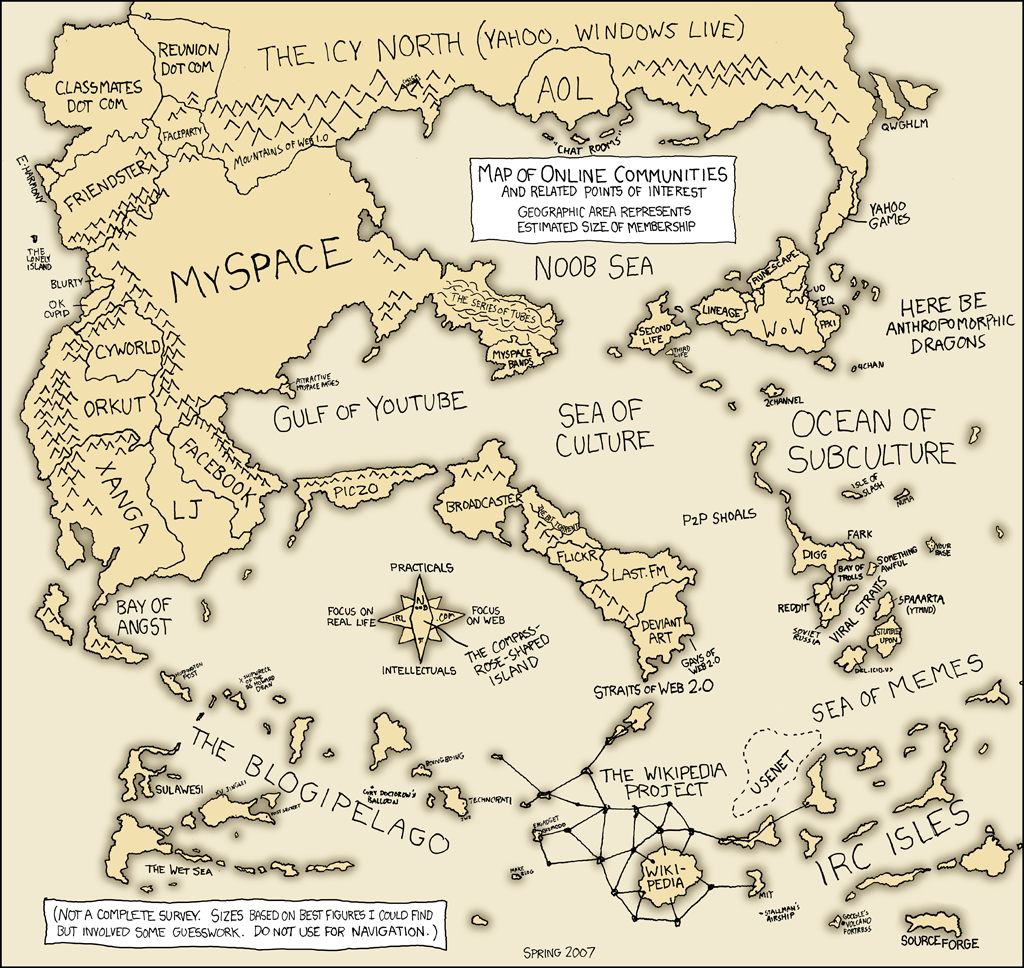
Finally, this map of online communities is my favorite thing of the day.
The CW: has the sum been less than the parts?
Does 24 need reinvention?
Do sweeps periods still matter?
Google: ready for a fight?
Perez: past the tipping point?
American Gladiators nostalgia, anyone?
Finally, this map of online communities is my favorite thing of the day.
5/01/2007
Pulp Muppets! Ok, so John Travolta is the logical Kermit and Uma Thurman can only be Miss Piggy. But I wasn't expecting Bruce Willis to be Beaker. (via MeFi) Bonus: Beaker sings "Memories."
4/30/2007
MiT5 wrapped up yesterday and it was an exhausting but really exciting weekend of scholarly exchange. I kept some tabs on events as they transpired on Twitter, which was fun (though some attendees seem to have resented the divided attention of laptop-enhanced participants). I have been enjoying reading blogs about attendees' conference experiences, including those by Derek, Jill, Chuck, Axel, and Jason.
Perhaps I'll write some more about the conference in the coming days. In the meantime, there are a few photos at my Flickr.
Update 5/1: Jean Burgess (who I heard give an excellent paper at MiT5 about Flickr and vernacular creativity) blogs about issues around Twittering the conference and the "continuous partial attention" that this requires:
And: My paper is now available in PDF form at the conference website. Or you can download it right here: "The Community as Artist: The Show with Ze Frank."
Perhaps I'll write some more about the conference in the coming days. In the meantime, there are a few photos at my Flickr.
Update 5/1: Jean Burgess (who I heard give an excellent paper at MiT5 about Flickr and vernacular creativity) blogs about issues around Twittering the conference and the "continuous partial attention" that this requires:
As far as I could see over people’s shoulders, and certainly in my own case, most of the time the twitterers were using their laptops and the internet to annotate, share, get background on, critique, and fact-check the papers they were listening to - and yes, they were also sometimes ‘playing around’ and socialising.The question to me is not only whether this parallel communication is a distraction from the conference presentation--it is and it isn't--but whether it's disrespectful to the person giving the paper. I don't think it is. My mind wanders all the time during conference panels. I find it hard to attend to every word of three or four papers consecutively, so I zone out for moments, scan the conference program, doodle, think about other things. Having a computer in front of me filled these times in addition to allowing me to annotate, share, etc. I don't see the harm in that. All the computer does is makes people's already partial and intermittent attention visible.
And: My paper is now available in PDF form at the conference website. Or you can download it right here: "The Community as Artist: The Show with Ze Frank."
4/27/2007
MiT5 kicked off this afternoon and I made it to parts of two plenaries and the entirety of two breakout sessions. Among several good papers I heard was Derek Johnson's on historicizing transmedia storytelling and media franchises. Derek was challenging Henry Jenkins's use of the term "transmedia" while Henry Jenkins was in the audience. That was my favorite part of the day.
My paper on web video and community-based authorship is tomorrow. As for today, here are some more impressions, bullet-point bloggy-style.
-Studying media in transition is shooting a moving target. So many of the speakers here seem to be trying to grapple with ongoing events, with shifting terrain and inchoate discourses, and some even concern themselves with forecasting future trends, which seems to me to go beyond the scholarly mandate of media studies. Studying an ongoing process is not easy, and it makes me wonder whether it might make better sense to wait awhile before writing about what's happening now. This actually makes me feel good about my major non-new-media project on independent cinema, which I think of as a book about something that has already happened rather than something that is developing as I write. (Of course independent cinema continues to develop, but it's also something that has taken shape over the years and assumed a fairly stable identity.)
-There are more open laptops here than I have ever seen at a conference, and from what I can tell from snooping over people's shoulders, most are being used in multitasking fashion, to read e-mail or have encounters in Second Life or scan RSS feeds while at the same time paying attention to a speaker. Just like my undergrads Facebooking in class.
-M.I.T.'s buildings are numbered as well as named, and so looking for your next panel means searching for E-15 or 4-253. This is confusing.
-At dinner I had clam chowder. I'm the kind of person who orders clam chowder in Boston, cuz that's what you do.
For more on MiT5, see Jill's blog. She's keeping track of various Twitter and blog responses to the conference. More to come.
[update 4/28: Jason has a more thorough discussion of the two panels we both attended yesterday.]
My paper on web video and community-based authorship is tomorrow. As for today, here are some more impressions, bullet-point bloggy-style.
-Studying media in transition is shooting a moving target. So many of the speakers here seem to be trying to grapple with ongoing events, with shifting terrain and inchoate discourses, and some even concern themselves with forecasting future trends, which seems to me to go beyond the scholarly mandate of media studies. Studying an ongoing process is not easy, and it makes me wonder whether it might make better sense to wait awhile before writing about what's happening now. This actually makes me feel good about my major non-new-media project on independent cinema, which I think of as a book about something that has already happened rather than something that is developing as I write. (Of course independent cinema continues to develop, but it's also something that has taken shape over the years and assumed a fairly stable identity.)
-There are more open laptops here than I have ever seen at a conference, and from what I can tell from snooping over people's shoulders, most are being used in multitasking fashion, to read e-mail or have encounters in Second Life or scan RSS feeds while at the same time paying attention to a speaker. Just like my undergrads Facebooking in class.
-M.I.T.'s buildings are numbered as well as named, and so looking for your next panel means searching for E-15 or 4-253. This is confusing.
-At dinner I had clam chowder. I'm the kind of person who orders clam chowder in Boston, cuz that's what you do.
For more on MiT5, see Jill's blog. She's keeping track of various Twitter and blog responses to the conference. More to come.
[update 4/28: Jason has a more thorough discussion of the two panels we both attended yesterday.]
4/23/2007
"The World Series of Uno" is the only web video I've seen lately that really excited me. Either there's a lull or I'm losing interest. Either way, blogging will continue to be light here for the near future.
I'm going to be at the MiT5 Conference this coming weekend in Cambridge, MA, so hope to see you there if you're planning on attending. (My paper is called "The Community as Artist: The Show with Ze Frank" and it will be posted to the conference website.) In the meantime, you can find me at Fraktastic, Twitter, Flickr, and del.icio.us. And please check out some of the excellent sites in my blogroll. ttyl.
4/17/2007
CNN has the Widest Screens

If this were my face, I'd be pissed. Why is this image (of a Virginia Tech student) being presented in this format? The 16x9 aspect ratio on CNN's online video player is presumably to accommodate widescreen footage in its original ratio. But when showing 4x3 footage, CNN uploads distorted 16x9 stretched to fit? It looks awful. Does the whole world really not notice? Is the impressiveness of filling the frame really so much more important than preserving the dignity of the subject? Here's another:

For comparison's sake, I looked at NBC news online at MSNBC. The player might be 16x9 but it preserves the 4x3 ratio when appropriate. Perhaps it's significant that this is a shot of a highly-paid anchor--they have a disincentive to make his appearance unappealing by stretching it horizontally.

And here's another comparison, to the online version of the NBC drama Heroes. Here the player is 4x3 and the original image is widescreen. The familiar letterboxing preserves the integrity of the subject.

4/16/2007
Happy Days Season 2 on DVD, which is available in the U.S. + Canada tomorrow, is being released with much of its original music replaced by generic muzak. Of about 50 original songs used in that season, just five have been retained. "Rock Around the Clock" has been replaced as the theme song with "Happy Days," which they started to use beginning season 3. "Blueberry Hill" appears once but it is omitted several other times.
It was only when reading through the list of omissions when I really realized how vital pop songs were to establishing Happy Days's setting. Some of the missing cuts on the DVD are "I'm Walking" by Fats Domino, "Wake Up Little Susie" by the Everly Brothers, "Sh-Boom" by the Crew Cuts, "Splish Splash" by Bobby Darin, and "Love Me Tender" by Elvis Presley. Just hearing these titles I start to see those 1970s blue checkerboard wipes from the Cunninghams' living room to the booth at Arnold's. I have probably watched more episodes of Happy Days than any other show in the history of television--I probably watched two episodes a day for about ten years--and the very idea of it missing these songs fills me with longing and regret. Releasing it without these bits of music would be like reproducing The Last Supper with a couple of Apostles missing.
As with the release of WKRP in Cincinnati on DVD, original music could have been licensed, but the distributor would have had to pay a steep price. The problem of licensing music for DVD highlights one of the excesses of copyright law. A more rational system might set a statutory rate for reuse of music in a television program released on DVD, just as radio stations pay statutory royalties to play songs. But obvs, our system wasn't designed to be maximally fair and the rights holder basically holds its content ransom. On the other hand, the distributor could charge more for the DVD and spend the extra cash on rights. But the market wouldn't support a very expensive Happy Days release. As Something Old, Nothing New notes, the first season DVD of HD did have all the orig music licensed, and it sold badly and lost money. The major media industries aren't in the business of preserving cultural heritage, alas.
No one gets rights from this video...yet, anyhow. It's "Yakety Yak" by The Coasters, performed at the Beacon Theater in New York in 1980 (followed by some super-cheesy stage shtick and then their even bigger hit, "Charlie Brown").
It was only when reading through the list of omissions when I really realized how vital pop songs were to establishing Happy Days's setting. Some of the missing cuts on the DVD are "I'm Walking" by Fats Domino, "Wake Up Little Susie" by the Everly Brothers, "Sh-Boom" by the Crew Cuts, "Splish Splash" by Bobby Darin, and "Love Me Tender" by Elvis Presley. Just hearing these titles I start to see those 1970s blue checkerboard wipes from the Cunninghams' living room to the booth at Arnold's. I have probably watched more episodes of Happy Days than any other show in the history of television--I probably watched two episodes a day for about ten years--and the very idea of it missing these songs fills me with longing and regret. Releasing it without these bits of music would be like reproducing The Last Supper with a couple of Apostles missing.
As with the release of WKRP in Cincinnati on DVD, original music could have been licensed, but the distributor would have had to pay a steep price. The problem of licensing music for DVD highlights one of the excesses of copyright law. A more rational system might set a statutory rate for reuse of music in a television program released on DVD, just as radio stations pay statutory royalties to play songs. But obvs, our system wasn't designed to be maximally fair and the rights holder basically holds its content ransom. On the other hand, the distributor could charge more for the DVD and spend the extra cash on rights. But the market wouldn't support a very expensive Happy Days release. As Something Old, Nothing New notes, the first season DVD of HD did have all the orig music licensed, and it sold badly and lost money. The major media industries aren't in the business of preserving cultural heritage, alas.
No one gets rights from this video...yet, anyhow. It's "Yakety Yak" by The Coasters, performed at the Beacon Theater in New York in 1980 (followed by some super-cheesy stage shtick and then their even bigger hit, "Charlie Brown").
4/13/2007
Variety reports on the digital camera's effects on acting. The ability to shoot continuously without worrying about wasting film, without having to call "roll sound" and "action" and "cut," is initiating a shift in the creative process of making films. The author of the piece, David S. Cohen, interviews Mel Gibson and Tony Bill, who have both recently shot films on digital cameras (Apocalypto and Flyboys, respectively).
Bill:
Cohen begins by announcing a revolution in acting style, but it seems from the description of the changes that what's really at stake is a directing style as much as an acting style, a new way for filmmakers to collaborate with their actors. I would still love to know more about how the finished product might be different. A matter for future research, for sure.
And another question: isn't the same thing happening in some television productions? Peter Berg and Jason Katims have discussed similar creative situations on the set of Friday Night Lights, and a big part of the spontaneous, natural, partly improvised aesthetic of that show comes from shooting in this more casual setup, with multiple cameras running continuously. (For instance, see the description of the filming of FNL at Wikipedia.) And yet, as far as I know, FNL is shot on film. Maybe there's more to this new style of shooting than just a technological innovation?
(via CinemaTech)
Bill:
For 100 years of acting on film, actors have had to cope with several technical limitations...they had to rehearse the scene before they shoot it. Then, once shooting begins, they have to act between reloads.And Gibson:
[...]
they have to act when the camera is running, not when it's not running. They're always aware there's film running through the camera, which is a tremendous burden for an actor, whether they know it or not.
[...]
This is going to change the way films are made, the way directors relate to actors, and the way actors relate to the camera. I think this will change acting as much as the Method changed acting.
It just gives you a little more room to experiment, to explore, to talk, and you're not burning this precious stock that's very expensive and runs out. It would have been a tragedy to burn all that film talking to them.The article goes on to describe the experience of Marley Shelton, who acted in both halves of Grindhouse. Rodriguez's portion was shot on video, and Tarantino's was shot on film. Shelton describes the difference in these processes. Rodriguez would gather actors around the playback monitor and everyone would watch the takes together. Tarnatino's style is more traditional.
Cohen begins by announcing a revolution in acting style, but it seems from the description of the changes that what's really at stake is a directing style as much as an acting style, a new way for filmmakers to collaborate with their actors. I would still love to know more about how the finished product might be different. A matter for future research, for sure.
And another question: isn't the same thing happening in some television productions? Peter Berg and Jason Katims have discussed similar creative situations on the set of Friday Night Lights, and a big part of the spontaneous, natural, partly improvised aesthetic of that show comes from shooting in this more casual setup, with multiple cameras running continuously. (For instance, see the description of the filming of FNL at Wikipedia.) And yet, as far as I know, FNL is shot on film. Maybe there's more to this new style of shooting than just a technological innovation?
(via CinemaTech)
4/12/2007
Things I love about "Ode to Zach Braff": the domestic mise en scene, the lip-synching, the piano playing, the cable-knit sweater, the line about the ATM PIN, the line about MySpace, the surgical scrubs, the "ZB for eva" tattoo, when the guy calls Zach "dog," and the whole casual faux gay panic thing. Pretty much everything. (The same creative folks made the much less tasteful Man's Best Friend With Benefits.)
NYT: "Not all is well with the Weinstein Company."
Slate is a-Twitter.
Jimmy Kimmel 1, Gawker 0.
Recently on Fresh Air: Jake Kasdan, Mike White, Peter Berg.
Ken Levine reports from the studio audience of Tuesday nite's Idol. Snarky but appreciative. Lisa de Moraes's WaPo blog is lively reading, too, if you're into this stuff.
And if it's in your power, please make these things go away asap: Imus, O'Reilly, the blogger code of conduct, Daniellyn, and Justin.tv.
Slate is a-Twitter.
Jimmy Kimmel 1, Gawker 0.
Recently on Fresh Air: Jake Kasdan, Mike White, Peter Berg.
Ken Levine reports from the studio audience of Tuesday nite's Idol. Snarky but appreciative. Lisa de Moraes's WaPo blog is lively reading, too, if you're into this stuff.
And if it's in your power, please make these things go away asap: Imus, O'Reilly, the blogger code of conduct, Daniellyn, and Justin.tv.
4/10/2007
Grindhouse flops! People who care about such things as who wins the weekly popularity contest called Box Office (I do care, just a little) are formulating their explanations for why the audience stayed away from a movie that seemed like such a sure thing. Harvey Weinstein himself offers some answers. The movie was too long. The audience, especially in flyover country, didn't get the concept. Both are probably factually true, but as explanations I'm not so sure. Did the grindhouse films of the 1970s earn boffo b.o.? Maybe the Grindhouse audience-that-wasn't did get the concept and expected crapola because the film was promoted as schlocky. Call this the so-bad-it's-bad explanation. Maybe. I haven't seen the film, so I really shouldn't opine. I will anyway.
Explaining why people go to see a movie is hard enough. Explaining why they do not see a movie is a mug's game. It has always vexed me that we generally assume a movie is popular because people like it, and unpopular because they don't. But you can't know that you'll like a movie until you have seen it, at which point you have already paid your money. Movies that are unpopular could potentially please lots of people, but they can't know that until they pay their $8. This is different from many other cultural experiences. We rarely buy music recordings without having heard some of them first. We rarely watch TV shows regularly that we have not already tuned into and liked.
With the impossibility of really knowing the motivations of millions of non-viewers in mind, here are some more reasons why a film like Grindhouse might fail:
-No big name stars. Regardless of how hot they are on the cover of Rolling Stone, Rose McGowan and Rosario Dawson don't open movies big.
-No clearly identifiable, bankable genre. Sorry, postmodern pastiche don't count. Neither does horror anthology.
-No pre-sold property (adaptation from a book or game, say).
-A confusing poster that makes the film seem like a revival (this is the point, but not everyone will get it).
-A title that doesn't refer to the content of the movie and that has to be explained to audiences at every opportunity. If you need to have it explained, that means you don't get it.
-The reviews. The fake trailers and the QT feature were generally well received, but few critics gave the Rodriguez feature a very positive notice, and...
-You have to sit through Planet Terror to get to Death Proof. This is a violation of a basic rule of double-feature programming: you snag the audience with the better film first, and keep them around to watch a weaker film with second billing.
-Most of the key moviegoing demographic, people my age and younger, is too young to have seen movies in grindhouses. The film tries to tap into nostalgia for something we don't remember. 70s retro is so, so dunzo.
Now for the explanations that smell to me like baloney:
-Too long. Long movies do well all the time.
-Easter weekend. Easter weekend is for family films. Yeah, and the studios used to avoid bringing out big new movies in the summer. I don't believe that people are so constrained by Easter weekend obligations as to avoid a movie they really want to see.
-There's something wrong with the audience--they're playing it safe, they're timid, they can't spot quality, etc. Joe Carnahan, who you might know as the director of the QT-manqué Smokin' Aces, writes in his blog:
Keep reading, movie fans: Mojo, Film Threat, Variety, Vidiocy, Poland, MovieJuice, MovingPictureBlog.
Explaining why people go to see a movie is hard enough. Explaining why they do not see a movie is a mug's game. It has always vexed me that we generally assume a movie is popular because people like it, and unpopular because they don't. But you can't know that you'll like a movie until you have seen it, at which point you have already paid your money. Movies that are unpopular could potentially please lots of people, but they can't know that until they pay their $8. This is different from many other cultural experiences. We rarely buy music recordings without having heard some of them first. We rarely watch TV shows regularly that we have not already tuned into and liked.
With the impossibility of really knowing the motivations of millions of non-viewers in mind, here are some more reasons why a film like Grindhouse might fail:
-No big name stars. Regardless of how hot they are on the cover of Rolling Stone, Rose McGowan and Rosario Dawson don't open movies big.
-No clearly identifiable, bankable genre. Sorry, postmodern pastiche don't count. Neither does horror anthology.
-No pre-sold property (adaptation from a book or game, say).
-A confusing poster that makes the film seem like a revival (this is the point, but not everyone will get it).
-A title that doesn't refer to the content of the movie and that has to be explained to audiences at every opportunity. If you need to have it explained, that means you don't get it.
-The reviews. The fake trailers and the QT feature were generally well received, but few critics gave the Rodriguez feature a very positive notice, and...
-You have to sit through Planet Terror to get to Death Proof. This is a violation of a basic rule of double-feature programming: you snag the audience with the better film first, and keep them around to watch a weaker film with second billing.
-Most of the key moviegoing demographic, people my age and younger, is too young to have seen movies in grindhouses. The film tries to tap into nostalgia for something we don't remember. 70s retro is so, so dunzo.
Now for the explanations that smell to me like baloney:
-Too long. Long movies do well all the time.
-Easter weekend. Easter weekend is for family films. Yeah, and the studios used to avoid bringing out big new movies in the summer. I don't believe that people are so constrained by Easter weekend obligations as to avoid a movie they really want to see.
-There's something wrong with the audience--they're playing it safe, they're timid, they can't spot quality, etc. Joe Carnahan, who you might know as the director of the QT-manqué Smokin' Aces, writes in his blog:
What is wrong with American moviegoers? Is there nothing NEW that they're willing to embrace? Jesus, it's the worst kind of erosion. We're making dumber and dumber films and they're becoming cash cows. God Bless '300', at least it's got balls and the director WENT for it. THAT movie is good for the business, it's good for everybody. But some of these other flicks don't even TRY because they know in the end, EXACTLY the age range and demographic driving ticket prices these days. Those monstrosities (the names of which I won't mention) are pure pieces of commerce, marketed to perfection.Kids these days, whatevs. I've seen Blades of Glory, which won the weekend, and it's a competent, funny movie with a strong cast and a decent script. It's no Miracle of Morgan's Creek, but then Smokin' Aces ain't exactly The Godfather, is it?
Keep reading, movie fans: Mojo, Film Threat, Variety, Vidiocy, Poland, MovieJuice, MovingPictureBlog.
4/08/2007
 An Inconvenient Truth, which we watched last night on DVD, is supposed to be a movie about global warming. But its true subject is Al Gore, and everything in it engineers our deep regret that Gore did not become the American president in 2001. He would have been so good at the job, the film implies. He's so smart, so thoughtful, so empathic and hardworking. And how much we pity him now, shlepping his own suitcase through airport concourses as he tours the world offering up his modest slideshow. In essence, An Inconvenient Truth is an extended opportunity for counterfactual musing: if Gore had been present, would there have been a War on Terror, or even a 9/11? Would there have been a bungled response to Hurricane Katrina, or even a Hurricane Katrina? The genius of the film is to connect our sense of urgency about global warming to the tragic loss of Gore--to make the 2000 election a narrative not only of Gore's personal loss, and not only America's, but all of humanity's.
There are passages in the film that actually have nothing to do with climate. Gore's childhood split between Washington and Tennessee. His son's injury at age six. His sister's death from lung cancer. They serve to humanize the speaker, to add to his credibility. He tries to connect them to his own journey toward greater knowledge about global warming and his efforts to do something about it, but ultimately they are there to characterize Gore and make us feel for him. They serve the argument by serving the person delivering it. I wasn't expecting the film to be so much about Gore, but this puts in perspective all the joking at the Oscars about his possible candidacy for president in 2008. It seems unlikely today, but if he decides to enter the race, An Inconvenient Truth will retroactively become a kind of campaign ad. And it has some of the flavor of a campaign ad in the way it positions the politician as a sympathetic regular guy, a good listener as well as a good speaker, and a family man.
The film ends with little messages in text interspersed among the credits encouraging spectators to reduce their carbon emissions, take public transit, drive hybrid cars, get an energy audit, etc. These are the only words in the film that do not come from Gore's voice, and they function to turn the film's ideas away from Gore's collective rhetoric--"we did this, now we can change"--toward an individualistic rhetoric--"you can do this and that." These messages undermine the film's agenda on two levels. First, the solution to global warming, like any massive social change, must come not only from individuals but from institutions, and emphasizing individual responsibility makes the need for political and corporate solutions seems relatively less urgent. More importantly, it takes the last word away from the film's true subject and makes him seem like just a spokesman. In An Inconvenient Truth, Gore is not just a spokesman--he's a character, a protagonist. The film tells the story of our role in changing the planet, but also Gore's role in coming to the point that he made a movie about climate rather than assuming the public office that might have given him the power to achieve something more direct. Whether he would really, practically, have been so empowered had history turned a different page in December, 2000, is another matter, and one the film doesn't consider.
4/07/2007
Ira Glass on Charlie Rose (begins around 32:00). I'm still not used to seeing Glass's face when I hear him speak.
4/05/2007
Virginia summarizes the Sopranos summary on YouTube (prev.), paying tribute to the art of the found footage video. It's great that the Grey Lady now publishes regular, respectful reviews of amateur videos posted online. Good for them. But the cycle of cool video surfaces → MSM story gives the background is getting a little predictable, and it makes recognition from the established press a kind of endorsement of value. Of course, it's the reverse of how the industrially-produced media generally work, which is for the audience to get the context (reviews, interviews, publicity, ads), then the text. It helps to have context to understand the text. But so much of what makes these online videos exciting is their very lack of context, their lack of standard valuation.
Now perhaps some able reporter can work on this story for next week: who is behind this inspired recreation of Do The Right Thing with Fisher-Price Sesame Street Toys?
Now perhaps some able reporter can work on this story for next week: who is behind this inspired recreation of Do The Right Thing with Fisher-Price Sesame Street Toys?
A few music links:
Ze Frank's songs have been made available from iTunes as an album. (via)
Via Stereogum: new Amy Winehouse-Pharaohe Monche remix of her excellent single "Rehab"; new Rufus Wainright track at Hard to Find a Friend.
If you have used Last.fm, you can find out here How Mainstream Are You? I'm 38% mainstream.
Ze Frank's songs have been made available from iTunes as an album. (via)
Via Stereogum: new Amy Winehouse-Pharaohe Monche remix of her excellent single "Rehab"; new Rufus Wainright track at Hard to Find a Friend.
If you have used Last.fm, you can find out here How Mainstream Are You? I'm 38% mainstream.
4/03/2007
Allessandra Stanley in the NYT offers a baggy Zeitgeist reading of American Idol's psychological appeal by relating it to our presidential electoral misadventures of the past few years. I don't have the energy to pick the whole thing over, and you can do it yourself if you're so inclined, but here is one bit that jumps out at me:
Ah well. That's enough for now. Tonight's show was good. Tony Bennett was the guest coach so the songs were all standards, and the show is at an advantage when the kids have to sing good songs.
Update 4/5: Chris Cagle has some thoughts about how to do a symptomatic reading of reality TV and legitimation.
It cannot be a coincidence that television voting rights arose so soon after the 2000 election left slightly more than half the voting population feeling cheated. Those who didn’t go to the polls and fear that their abstention inadvertently made possible the invasion of Iraq may feel even worse. “Idol” could be a displacement ritual: a psychological release that allows people to vote — and even vote often — in a contest that has no dangerous or even lasting consequences.Yeah, it can be a coincidence. As a rule, when a writer begins a point by denying a coincidence, you can be pretty sure that they're about to make an injudicious leap. And aside from the vacuousness of relating things so little connected, this argument makes no allowance for the large number of Idol voters who don't feel guilty about 2000 because they were too young to vote or because they never vote and don't care. And clearly to the fan, Idol has serious and lasting consequences. That's why people care about a vote-for-the-worst candidate prevailing.
Ah well. That's enough for now. Tonight's show was good. Tony Bennett was the guest coach so the songs were all standards, and the show is at an advantage when the kids have to sing good songs.
Update 4/5: Chris Cagle has some thoughts about how to do a symptomatic reading of reality TV and legitimation.
Random:
Hipster indie music snobs skewered (via gf, who links to this video with nothing but the description "word document")
Last nite I saw The Host (scary monster!) and before it the trailer for Year of the Dog, which looks great. Has anyone compared The Host and Pan's Labyrinth? I'm too lazy to Google it, but there's certainly something there with young girls, disgusting creatures, and politically-themed global genre cinema. (See also, NYT profile of Molly Shannon.)
IHT on Helvetica, an appreciation of "a democratic luxury."
Wikipedia: Five-Second Rule.
NYMag on the Viacom-YouTube lawsuit is the best analysis I have read. Google, according to this account, has a kind of corporate Asperger's syndrome that makes it oblivious of other corporations and their psychology. (See also The Economist on Google and the future of books.)
The Chron picks its favorite campus prank web videos. (via a+l)
A sneak-peek at TV Guide's forthcoming web video portal/search. I always want to buy TV Guide at the supermarket, their covers are so appealing. But it always seems like a waste of money.
Sanjaya drops by Weekend Update. I am so glad that the web has made it unnecessary for me to watch the 1:27 of SNL each week that isn't worth my time. I hope Sanjaya sticks around a few more weeks b/c he's more interesting TV than some of these other bland nobodies. I think he will. (See also Jenkins on idolhacking.)
Hipster indie music snobs skewered (via gf, who links to this video with nothing but the description "word document")
Last nite I saw The Host (scary monster!) and before it the trailer for Year of the Dog, which looks great. Has anyone compared The Host and Pan's Labyrinth? I'm too lazy to Google it, but there's certainly something there with young girls, disgusting creatures, and politically-themed global genre cinema. (See also, NYT profile of Molly Shannon.)
IHT on Helvetica, an appreciation of "a democratic luxury."
Wikipedia: Five-Second Rule.
NYMag on the Viacom-YouTube lawsuit is the best analysis I have read. Google, according to this account, has a kind of corporate Asperger's syndrome that makes it oblivious of other corporations and their psychology. (See also The Economist on Google and the future of books.)
The Chron picks its favorite campus prank web videos. (via a+l)
A sneak-peek at TV Guide's forthcoming web video portal/search. I always want to buy TV Guide at the supermarket, their covers are so appealing. But it always seems like a waste of money.
Sanjaya drops by Weekend Update. I am so glad that the web has made it unnecessary for me to watch the 1:27 of SNL each week that isn't worth my time. I hope Sanjaya sticks around a few more weeks b/c he's more interesting TV than some of these other bland nobodies. I think he will. (See also Jenkins on idolhacking.)
3/30/2007
YouTube to become more Flickr-like, sez Beet.tv, by organizing videos in categories. I like the idea of a website being like Flickr, but is the way it's using categories anything more sophisticated than Yahoo! c. 1997?
A user-generated recap of all of The Sopranos eps to date is outstanding work. Also, see bigscreenlittlescreen on the odds of your favorite and least favorite characters surviving the final season.
Laugh through your fear: a daring videographer crosses the street in Hyderabad. (via)
Give it up for MC Rove in the house, oy vey.
Cute attack: kitty makes a movie. See also parts 2, 3, 4, 5. (via)
NewTeeVee has a nice post about web video serials, including Chad Vader and the forthcoming Prom Queen.
I saw Inland Empire the other night and found it ponderous and ugly. More response to come, if I feel like spending more time thinking about a movie I didn't like. But searching for clips online I found this video of guys running into Lynch when he was camped out in L.A. with a cow and a "for your consideration" poster pimping Laura Dern to the Academy. I liked this better than Inland Empire.
And JibJab is back with What We Call The News, the best of the week for sure.
A user-generated recap of all of The Sopranos eps to date is outstanding work. Also, see bigscreenlittlescreen on the odds of your favorite and least favorite characters surviving the final season.
Laugh through your fear: a daring videographer crosses the street in Hyderabad. (via)
Give it up for MC Rove in the house, oy vey.
Cute attack: kitty makes a movie. See also parts 2, 3, 4, 5. (via)
NewTeeVee has a nice post about web video serials, including Chad Vader and the forthcoming Prom Queen.
I saw Inland Empire the other night and found it ponderous and ugly. More response to come, if I feel like spending more time thinking about a movie I didn't like. But searching for clips online I found this video of guys running into Lynch when he was camped out in L.A. with a cow and a "for your consideration" poster pimping Laura Dern to the Academy. I liked this better than Inland Empire.
And JibJab is back with What We Call The News, the best of the week for sure.
3/28/2007
Tumblr and the Immersive Internet
For some people it's hootch or craps or Lifetime movies. Lately for me it's these nifty web 2.0 apps. I can't hear even the vaguest hint of hype about a single one of these things without signing myself up. I was already neck deep in blog, flickr, and del.icio.us and that seemed like quite enough. Turns out Silicon Valley was just getting started with me. I started editing Wikipedia pages when I found things that needed work. I've already linked here to my documents on Scribd. I became dabbler in Digg, I've been known to Stumble, and there is a Facebook page with a goofy picture of me on it, search if you must. I have a MySpace though there's nothing there and the only MySpacers who friend me are girls who seem to think I might be interested in, you know. And there's YouTube. I shot some home videos and posted them there. I'm not going to link to them because my sister was embarrassed enough when her third-graders discovered them and she's not looking for more exposure.
And what about RSS? Most earthlings seem to manage without, but these days I'm using three separate RSS apps. NetNewsWire Lite is the one I use most often at home on my desktop computer because it's fastest. (I am subscribed to 285 feeds, which seems like too many.) Netvibes is another I like because it shows me so much in one place and it's just so awesome and cool. And Google Reader works well when I'm on a computer away from home and want to scan just a few feeds in a short period of time (Netvibes takes a little longer to fire up).
Twitter! How did I ever manage without twitter! I love it so much I signed up my mom! Now she twitters too. Friend her if you like. She does lots of interesting stuff, as you will find out.
Now there's this new web app that I just started playing with called Tumblr. A Tumblelog is a kind of stripped down blog--more like a scrapbook than an essayistic or diaristic blog--and it's a form that's been around awhile. One of its distinctive features is that it has different formatting styles for different types of entries: posts, links, quotes, conversations, pictures, videos. When you find something on the web that you want to share, you add it to your tumblelog, so this makes it similar to a linklog like Kottke or Fimoculous. Tumblr is a new, free, Blogger-style service that allows you easily to create a tumblelog using premade templates. (To view examples, see Tumblr Radar, which aggregates recently updated Tumbls.) And like Twitter and del.icio.us, posting to Tumblr is much easier than creating a blog entry using Blogger (or WordPress or other alternatives). You click "post to Tumbl" on a toolbar button and up comes a window that allows for quick entry. Like Twitter, Tumblr makes posting things to the web very easy, easier than a typical blog. But unlike a blog, a Tumbl lacks many social features like a default setting for a blogroll, comments, trackbacks, profiles, etc. It's easy to use in part because it has a small number of features. But a small number of features is actually a virtue, because it allows you to focus on certain things but not others.
I can foresee the term "blog" fading away or shifting meaning as these new forms like Tumblr and Twitter emerge. Lately so many blogs seem to offer magazine-style content, articles and essays in polished prose. I have written some such entries here. Maybe this very entry. But another form of self-publishing online is more about collecting or curating or tracking an ongoing experience than it is like expository writing or punditry. I want to participate in all of these things, but the blog as it is now may not be the best option for the fast, ongoing, process-oriented web publishing. When I find something online that I want to save or share, I may not have much to say about it aside from, "look at this." The form of the blog and the means of posting to it put pressure on the content to be of a certain quality, to be significant and relatively thorough, and to fit the blog's theme. If you're going to take the trouble to blog it, it had better be good. Often I just want to post things I find, though, that don't rise to this level. Often I want to save or share something about which I have no big point to make, and I feel that pointless (or, more like it, point-poor) blog entries are lame.
So I have been playing around with the Tumblr interface and testing its possibilities. I think it's potentially incredibly useful and fun. I don't know that I want to keep doing it for the long term. Maybe it will get tiring. Who knows. The site I created just yesterday is called Fraktastic in homage to Battlestar Galactica (which just jumped the shark, unfortch). It's nothing much, but it suggests what sort of thing one might do with the tool.
The problem, of course, is that I have too many of these things running at once and I'm going to have trouble keeping track of them all. I can't imagine you want to keep track of them all, either. Maybe what I really need is an integrated personal data stream, a consolidated RSS feed that combines all my stuff. But not all of my stuff really belongs together. My pictures and videos, my Wikipedia work, my scholarly work, my non-scholarly writing (e.g., twitter), etc., don't seem to me to all belong in one omnibus Michael Newman place. I'm not sure why, it just doesn't seem appropriate. Making sense of the relative integration or fragmentation of the personal web experience might be a challenge facing those at work on web apps of the future.
Additional reading:
Emily Chang on the personal data stream, with lots of links.
Kottke on tumblelogs in 2005.
Lifehacker review of Tumblr.
Another Tumblr review, at heyblog, with this intriguing design-y passage:
And what about RSS? Most earthlings seem to manage without, but these days I'm using three separate RSS apps. NetNewsWire Lite is the one I use most often at home on my desktop computer because it's fastest. (I am subscribed to 285 feeds, which seems like too many.) Netvibes is another I like because it shows me so much in one place and it's just so awesome and cool. And Google Reader works well when I'm on a computer away from home and want to scan just a few feeds in a short period of time (Netvibes takes a little longer to fire up).
Twitter! How did I ever manage without twitter! I love it so much I signed up my mom! Now she twitters too. Friend her if you like. She does lots of interesting stuff, as you will find out.
Now there's this new web app that I just started playing with called Tumblr. A Tumblelog is a kind of stripped down blog--more like a scrapbook than an essayistic or diaristic blog--and it's a form that's been around awhile. One of its distinctive features is that it has different formatting styles for different types of entries: posts, links, quotes, conversations, pictures, videos. When you find something on the web that you want to share, you add it to your tumblelog, so this makes it similar to a linklog like Kottke or Fimoculous. Tumblr is a new, free, Blogger-style service that allows you easily to create a tumblelog using premade templates. (To view examples, see Tumblr Radar, which aggregates recently updated Tumbls.) And like Twitter and del.icio.us, posting to Tumblr is much easier than creating a blog entry using Blogger (or WordPress or other alternatives). You click "post to Tumbl" on a toolbar button and up comes a window that allows for quick entry. Like Twitter, Tumblr makes posting things to the web very easy, easier than a typical blog. But unlike a blog, a Tumbl lacks many social features like a default setting for a blogroll, comments, trackbacks, profiles, etc. It's easy to use in part because it has a small number of features. But a small number of features is actually a virtue, because it allows you to focus on certain things but not others.
I can foresee the term "blog" fading away or shifting meaning as these new forms like Tumblr and Twitter emerge. Lately so many blogs seem to offer magazine-style content, articles and essays in polished prose. I have written some such entries here. Maybe this very entry. But another form of self-publishing online is more about collecting or curating or tracking an ongoing experience than it is like expository writing or punditry. I want to participate in all of these things, but the blog as it is now may not be the best option for the fast, ongoing, process-oriented web publishing. When I find something online that I want to save or share, I may not have much to say about it aside from, "look at this." The form of the blog and the means of posting to it put pressure on the content to be of a certain quality, to be significant and relatively thorough, and to fit the blog's theme. If you're going to take the trouble to blog it, it had better be good. Often I just want to post things I find, though, that don't rise to this level. Often I want to save or share something about which I have no big point to make, and I feel that pointless (or, more like it, point-poor) blog entries are lame.
So I have been playing around with the Tumblr interface and testing its possibilities. I think it's potentially incredibly useful and fun. I don't know that I want to keep doing it for the long term. Maybe it will get tiring. Who knows. The site I created just yesterday is called Fraktastic in homage to Battlestar Galactica (which just jumped the shark, unfortch). It's nothing much, but it suggests what sort of thing one might do with the tool.
The problem, of course, is that I have too many of these things running at once and I'm going to have trouble keeping track of them all. I can't imagine you want to keep track of them all, either. Maybe what I really need is an integrated personal data stream, a consolidated RSS feed that combines all my stuff. But not all of my stuff really belongs together. My pictures and videos, my Wikipedia work, my scholarly work, my non-scholarly writing (e.g., twitter), etc., don't seem to me to all belong in one omnibus Michael Newman place. I'm not sure why, it just doesn't seem appropriate. Making sense of the relative integration or fragmentation of the personal web experience might be a challenge facing those at work on web apps of the future.
Additional reading:
Emily Chang on the personal data stream, with lots of links.
Kottke on tumblelogs in 2005.
Lifehacker review of Tumblr.
Another Tumblr review, at heyblog, with this intriguing design-y passage:
I’m sure you’ll agree that the world hardly needs another blogging or meta-blogging service, but it’s worth signing up for Tumblr just to check out its design. Like online portfolio service Carbonmade, it nails some current design trends—big fonts, gradients, “simplicity”, clever writing—in really thoughtful and appropriate ways, without looking merely trendy. In both applications, stuff you do once is big and easy, and stuff you do often is accessible and quick. Even the sign-up confirmation email is lovely. It’s also nice that Tumblr’s not overly Ajax-y, too, except where it’s really useful (like previewing your design changes).
3/27/2007
Adaptation 2.0: Feature filmmakers have been adapting novels into movies for a hundred years. Now on the internet, some fans have adapted a few blog entries by Maureen Johnson, a writer they admire, into into a cute YouTube video, "How to Write a Book," about the process of creating fiction. Read about the experience of seeing your blog adapted into video at Maureen's blog. (via Shaken & Stirred)
Related: LAT reports that "the Internet is giving Hollywood a nervous breakdown." What else is new?
Only sort of related: background on the Spiders on Drugs video; background on the Huckabees meltdown video.
Not at all related: Sanjaya hairstyle cut-outs from the WaPo.
Related: LAT reports that "the Internet is giving Hollywood a nervous breakdown." What else is new?
Only sort of related: background on the Spiders on Drugs video; background on the Huckabees meltdown video.
Not at all related: Sanjaya hairstyle cut-outs from the WaPo.
3/24/2007
Ron Moore, the Battlestar Galactica showrunner, is interviewed in Salon about the show's political themes, the process of telling serialized stories, and the future of the series.
Our main title every week says "A Search for Earth," and at some point you gotta find earth, or it becomes "Gilligan's Island." The audience loses faith that you're ever going to get anywhere and the cylons are never going to destroy the Galactica and what's the point. We've always felt that there's an end to this show, and we've moved into the third act of a three-act structure.
3/23/2007
VHS Lives!

Shorewood Public Library, children's section, Shorewood, WI.
I thought we were through with tape, but not so fast. We share our home entertainment with a 3 year-old named Leo, and Leo's favorite thing these days is to walk to the public library down the street to borrow video cassettes of his shows (these days, Teletubbies and Thomas and Friends are the ones he gets out of the library, though Disney's Little Einsteins--too new to be available on tape at all as far as I can tell--is his hottest passion at the moment). At first when he discovered the public library's collection of his shows he was ecstatic and I was dejected. Not tape! I said goodbye to all that! But it quickly became apparent that VHS tapes of children's shows have several advantages over DVDs. They lend for a week whereas DVDs only go out for three days. They're more suitable for a young child to handle. I don't want him putting his fingers on discs, but he's actually good at jockeying tapes. They play automatically when inserted and he knows how to use the stop/eject button. By comparison, he's not yet sophisticated enough to control the DVD player, to know the menu button and the magical means of skipping boring previews.
And to be honest, I kind of like tapes. They make me nostalgic for the old days. And having to rewind them before we take them back to the library makes me feel like I'm doing a good deed.
Anyhow the point of this is: reports of the format's death are exaggerated.
Shorewood Public Library, children's section, Shorewood, WI.
I thought we were through with tape, but not so fast. We share our home entertainment with a 3 year-old named Leo, and Leo's favorite thing these days is to walk to the public library down the street to borrow video cassettes of his shows (these days, Teletubbies and Thomas and Friends are the ones he gets out of the library, though Disney's Little Einsteins--too new to be available on tape at all as far as I can tell--is his hottest passion at the moment). At first when he discovered the public library's collection of his shows he was ecstatic and I was dejected. Not tape! I said goodbye to all that! But it quickly became apparent that VHS tapes of children's shows have several advantages over DVDs. They lend for a week whereas DVDs only go out for three days. They're more suitable for a young child to handle. I don't want him putting his fingers on discs, but he's actually good at jockeying tapes. They play automatically when inserted and he knows how to use the stop/eject button. By comparison, he's not yet sophisticated enough to control the DVD player, to know the menu button and the magical means of skipping boring previews.
And to be honest, I kind of like tapes. They make me nostalgic for the old days. And having to rewind them before we take them back to the library makes me feel like I'm doing a good deed.
Anyhow the point of this is: reports of the format's death are exaggerated.
3/22/2007
The Criterion Contraption is like The Julie/Julia Project but with movies and longer than a year.
Ashley, the crying Idol fan, on people who think Sanjaya's not so good (pity Meredith V. for having to ask): "I just like say they're wrong or just ignore them." You go, Ashley!
This American Life parody by Kaspar Hauser is pretty spot on. (via Lindsayism)
Graphpaper, a design blog, opines about one of the things that irritates me beyond all reason: 16x9 televisions showing 4x3 frames with horizontal distortion. The blogger seems to think some people are just visually dull and can't see the way sophisticates like him can. I would say it's more a matter of what you are in the habit of paying attention to. Designers, like media scholars, pay attention to different things from ordinary folks, and that's a point we can sometimes forget.
Ashley, the crying Idol fan, on people who think Sanjaya's not so good (pity Meredith V. for having to ask): "I just like say they're wrong or just ignore them." You go, Ashley!
This American Life parody by Kaspar Hauser is pretty spot on. (via Lindsayism)
Graphpaper, a design blog, opines about one of the things that irritates me beyond all reason: 16x9 televisions showing 4x3 frames with horizontal distortion. The blogger seems to think some people are just visually dull and can't see the way sophisticates like him can. I would say it's more a matter of what you are in the habit of paying attention to. Designers, like media scholars, pay attention to different things from ordinary folks, and that's a point we can sometimes forget.
3/20/2007
Friday Night Lights gets some lavish attention from Maureen Ryan's blog The Watcher: interviews with more than half a dozen cast members and with Jeffrey Reiner, a co-exec producer and director of many episodes; Jason Katims, the showrunner; and Kevin Reilly, NBC's entertainment president. These include a wealth of details about the show's production practices, how it achieves its visual style, and NBC's strategies in marketing the program.
3/19/2007
Twitter has been running really slow, and you can imagine the vast multitudes eagerly reporting their quotidian events as the page labors to get your data up for you. It's exciting to see something that didn't exist three seconds ago become part of the fabric of people's lives. Of course the commentariat is working hard to make sense of it:
The Wall Street Journal got in on the action early, and was pleasantly non-snarky about it. (Reading this article doesn't require a subscription.)
Lifehack thinks you should use Twitter productively. Like so many of these social web apps, Twitter could be either a way to steal time or a way to take care of business. I get more excited by stealing time, myself. See also Slacker Manager.
Bokardo: Twitter's genius is that it combines the read and write screens. I second.
Apophenia: thoughts on Twitter esp as it is used by mobile persons. I myself tend to be stationary. Reading this made me feel old, cuz I have just about no one to text with mobile to mobile and just about no interest in getting into this. My Twittering is old-skool web-based only.
Headrush: on the implications of Twitter for your brain.
Inevitably, someone had to invent the ghastly phrase "twittering point".
And two nice Twitter tools: Ludicrous offers a way to post to Twitter from the Firefox search box (don't embarrass yourself by posting to Twitter by mistake when you're trying to search Google, friends). Twittervision is a map-Twitter mashup that shows posts as they happen from all around this rock we call Earth. That's incredible!
The Wall Street Journal got in on the action early, and was pleasantly non-snarky about it. (Reading this article doesn't require a subscription.)
Lifehack thinks you should use Twitter productively. Like so many of these social web apps, Twitter could be either a way to steal time or a way to take care of business. I get more excited by stealing time, myself. See also Slacker Manager.
Bokardo: Twitter's genius is that it combines the read and write screens. I second.
Apophenia: thoughts on Twitter esp as it is used by mobile persons. I myself tend to be stationary. Reading this made me feel old, cuz I have just about no one to text with mobile to mobile and just about no interest in getting into this. My Twittering is old-skool web-based only.
Headrush: on the implications of Twitter for your brain.
Inevitably, someone had to invent the ghastly phrase "twittering point".
And two nice Twitter tools: Ludicrous offers a way to post to Twitter from the Firefox search box (don't embarrass yourself by posting to Twitter by mistake when you're trying to search Google, friends). Twittervision is a map-Twitter mashup that shows posts as they happen from all around this rock we call Earth. That's incredible!
3/18/2007
At Wagmedia, a new blog by an old friend, Ira Wagman is discussing Henry Jenkins's Convergence Culture. In particular he wonders whether all the attention being given to the new participatory culture is slighting the casual audiences--still the vast majority of culture consumers--who aren't interested in making fan fiction or researching Survivor locations to spoil upcoming seasons or following narratives across multiple platforms. Ira writes:
-Is participatory culture significant because it represents a prevailing mode of engaging with media? Certainly it is not that now. I kept wondering as I was reading CC whether its argument hangs on a prediction for the future. Perhaps participatory culture is poised to become a standard way for a significant number of people to engage with media. But perhaps not. Maybe participatory culture will remain a minority, niche pursuit that is more available to those with the benefits of social and economic privilege.
-Maybe even if inequality between cultural consumers is overcome in the future, most people still won't be interested in the modes of media interaction Jenkins champions. As it is now, most people who have the education and technology necessary to engage in read/write culture (as opposed to read-only culture) aren't interested. I have been noticing this more and more as I become immersed in the read/write culture myself. For instance, most people I talk to have no idea what an RSS feed is and when I tell them about it, they react like I'm trying to sell them encyclopedias. My students, whose age might indicate they are more likely than I am to know about such things, need me to define terms like "mashup." The experience of media as an immersive obsession isn't for everyone. Most people don't use media that way, and why should they? They have a lot of other things to do. My sense is that the norm is still to use the web for e-mail, shopping, looking things up, and little else--i.e., not the way you and I use it.
-Even when people are up for an immersive experience, they might prefer the role of spectator to that of participant. Participation isn't usually what we're looking for in our entertainment. I love movies and TV because they come to me, they please me, they offer me so much. In return, I often give them nothing more than my attention and interest. And this is robustly satisfying--nothing seems to be missing from the experience. Jenkins's examples are all of spectators becoming active in the co-creation of media. I too am excited by this activity, but I am not totally comfortable with the unambiguous positive moral valence this is given. It suggests that the comparative passivity of non-co-creating viewers is a less worthy mode of engagement and prescribes a certain kind of viewing activity as preferable. I'm sure Jenkins doesn't mean to be prescriptive in this way, but this is the implication I draw from the way he stakes his position.
So in general: maybe participatory culture isn't for everyone. Maybe it's being adopted as a marketing concept by media companies eager to find the next big thing. Maybe read-only culture has a lot of life left in it yet.
Do we really want television made by and for fans? What happens to the casual (and not passive) viewer? They're important too, aren't they?I had some similar responses when I read the book. In general I am really excited by the developments Jenkins writes about, but I also have some reservations about the way scholars talk about them. Such as...
-Is participatory culture significant because it represents a prevailing mode of engaging with media? Certainly it is not that now. I kept wondering as I was reading CC whether its argument hangs on a prediction for the future. Perhaps participatory culture is poised to become a standard way for a significant number of people to engage with media. But perhaps not. Maybe participatory culture will remain a minority, niche pursuit that is more available to those with the benefits of social and economic privilege.
-Maybe even if inequality between cultural consumers is overcome in the future, most people still won't be interested in the modes of media interaction Jenkins champions. As it is now, most people who have the education and technology necessary to engage in read/write culture (as opposed to read-only culture) aren't interested. I have been noticing this more and more as I become immersed in the read/write culture myself. For instance, most people I talk to have no idea what an RSS feed is and when I tell them about it, they react like I'm trying to sell them encyclopedias. My students, whose age might indicate they are more likely than I am to know about such things, need me to define terms like "mashup." The experience of media as an immersive obsession isn't for everyone. Most people don't use media that way, and why should they? They have a lot of other things to do. My sense is that the norm is still to use the web for e-mail, shopping, looking things up, and little else--i.e., not the way you and I use it.
-Even when people are up for an immersive experience, they might prefer the role of spectator to that of participant. Participation isn't usually what we're looking for in our entertainment. I love movies and TV because they come to me, they please me, they offer me so much. In return, I often give them nothing more than my attention and interest. And this is robustly satisfying--nothing seems to be missing from the experience. Jenkins's examples are all of spectators becoming active in the co-creation of media. I too am excited by this activity, but I am not totally comfortable with the unambiguous positive moral valence this is given. It suggests that the comparative passivity of non-co-creating viewers is a less worthy mode of engagement and prescribes a certain kind of viewing activity as preferable. I'm sure Jenkins doesn't mean to be prescriptive in this way, but this is the implication I draw from the way he stakes his position.
So in general: maybe participatory culture isn't for everyone. Maybe it's being adopted as a marketing concept by media companies eager to find the next big thing. Maybe read-only culture has a lot of life left in it yet.
The Show With Ze Frank, 2006-2007
Ze Frank took his curtain call yesterday and, just like TV, the internet breaks your heart. We come to need our TV friends on schedule and then one day they're just gone, the show's over, it's never coming back. Reruns remind us of what was once, but they're never the real McCoy. So it is now with our internet friends.
The Show was one example of a new kind of art form, one made by an ongoing collaboration of a performer and dozens, hundreds, even thousands of participants dispersed around the country and the world and connected by the internet. The community created something that only a web-based network could achieve. Frank is certainly a remarkable talent, but he alone could not have made The Show. For its potential to be realized, many hands had to set to work. Its special energy came from knowing that every day the sportsracers were ready to interact in the creative effort. All art is the product of a network of cooperation, but the internet is providing opportunities to adjust the balance between artists and support personnel in favor of more democratic arrangements.
Today's LAT has a nice primer+appreciation (thx Chuck). Here are some of my favorite episodes. There are 250 in total, so this list could be way longer.
The sportsracer show, in which the audience thanks Ze for The Show.
Ze takes the sportsracers's recordings to Ray, whose song they remixed and turned into a video.
The ep with Ze's holiday song (at the end) naming all the political figures in the news in his polyphonic a capella vocals. I've watched this one about seven hundred times and it never gets old.
Ze barfs out Scrabble tiles. In response, Valleywag wrote, "Ze Frank is one of the very few new web video stars with that attribute they used to call, um, talent."
Thanksgiving won much praise in the blogs for the way it captures family dynamics.
The episode in which Ze picks a fight with Rocketboom over their use of metrics to measure the size of their audience, sardonic in its assessment of differences between old and new media.
"Left turn ok" is the very meta episode with a stream-of-consciousness voice-over from the mind of a skeptical viewer. I really love this one.
A first installment on the ins and outs of videoblogging is mercilessly mocking.
On college being only sort of like the real world; in the next one on this topic: choosing a major is like choosing where to live.
"Fingers in Food" is a lot too zany. The next day begins, "Are the new viewers gone yet?"
"Jon Benet" is one of the best eps, a parody of bizlit bullshit about brands.
For his 100th episode, Ze reminisces about childhood, growing up as a child of immigrants. This one has an unusual non-comic tone.
On copyright, YouTube and participatory culture.
"Condoleeza's Magic Satchel" gonna save the day, one of the crazier songs.
Ugly MySpace contestants introduced + the "I know me some ugly song" + the defense of amateur aesthetics in the user-generated content age. This is one of the very best.
Ideas are like brain crack. Classic.
Fabuloso Friday: the viewers wrote the script of this one and although it doesn't quite work as an episode, it's a feat of collaboration nonetheless.
"Austrian Arrows" answers the question "are you gay?" No, Ze says, but I like gay things. Then a segment about all the gay things Ze likes. This ep also has Ze doing a hilarious Austrian accent.
"Summer Jamz" introduces new viewers to all of The Show's inside jokes in a way that makes no sense to new viewers.
The episode "anti-intellectualism" has one of my favorite Ze songs. It goes, "Let's watch the monkey dance, anti-intellectualism!/Make fun of the south of France, anti-intellectualism!..."
"Are the New Viewers Gone Yet?" An episode begins with boring stuff to turn away people who don't watch regularly. Then Ze asks, "Are the new viewers gone yet?" When I was a new viewer, this bit was one of things that made me love The Show.
An early episode mocks Starbucks, a favorite target, and includes a beloved song, "Who loves the little duckies in the pond..." The duckie became Frank's mascot.
"Yes No I This Is," one of GWB's mangled attempts at making sense, became an inside joke.
The Show was one example of a new kind of art form, one made by an ongoing collaboration of a performer and dozens, hundreds, even thousands of participants dispersed around the country and the world and connected by the internet. The community created something that only a web-based network could achieve. Frank is certainly a remarkable talent, but he alone could not have made The Show. For its potential to be realized, many hands had to set to work. Its special energy came from knowing that every day the sportsracers were ready to interact in the creative effort. All art is the product of a network of cooperation, but the internet is providing opportunities to adjust the balance between artists and support personnel in favor of more democratic arrangements.
Today's LAT has a nice primer+appreciation (thx Chuck). Here are some of my favorite episodes. There are 250 in total, so this list could be way longer.
The sportsracer show, in which the audience thanks Ze for The Show.
Ze takes the sportsracers's recordings to Ray, whose song they remixed and turned into a video.
The ep with Ze's holiday song (at the end) naming all the political figures in the news in his polyphonic a capella vocals. I've watched this one about seven hundred times and it never gets old.
Ze barfs out Scrabble tiles. In response, Valleywag wrote, "Ze Frank is one of the very few new web video stars with that attribute they used to call, um, talent."
Thanksgiving won much praise in the blogs for the way it captures family dynamics.
The episode in which Ze picks a fight with Rocketboom over their use of metrics to measure the size of their audience, sardonic in its assessment of differences between old and new media.
"Left turn ok" is the very meta episode with a stream-of-consciousness voice-over from the mind of a skeptical viewer. I really love this one.
A first installment on the ins and outs of videoblogging is mercilessly mocking.
On college being only sort of like the real world; in the next one on this topic: choosing a major is like choosing where to live.
"Fingers in Food" is a lot too zany. The next day begins, "Are the new viewers gone yet?"
"Jon Benet" is one of the best eps, a parody of bizlit bullshit about brands.
For his 100th episode, Ze reminisces about childhood, growing up as a child of immigrants. This one has an unusual non-comic tone.
On copyright, YouTube and participatory culture.
"Condoleeza's Magic Satchel" gonna save the day, one of the crazier songs.
Ugly MySpace contestants introduced + the "I know me some ugly song" + the defense of amateur aesthetics in the user-generated content age. This is one of the very best.
Ideas are like brain crack. Classic.
Fabuloso Friday: the viewers wrote the script of this one and although it doesn't quite work as an episode, it's a feat of collaboration nonetheless.
"Austrian Arrows" answers the question "are you gay?" No, Ze says, but I like gay things. Then a segment about all the gay things Ze likes. This ep also has Ze doing a hilarious Austrian accent.
"Summer Jamz" introduces new viewers to all of The Show's inside jokes in a way that makes no sense to new viewers.
The episode "anti-intellectualism" has one of my favorite Ze songs. It goes, "Let's watch the monkey dance, anti-intellectualism!/Make fun of the south of France, anti-intellectualism!..."
"Are the New Viewers Gone Yet?" An episode begins with boring stuff to turn away people who don't watch regularly. Then Ze asks, "Are the new viewers gone yet?" When I was a new viewer, this bit was one of things that made me love The Show.
An early episode mocks Starbucks, a favorite target, and includes a beloved song, "Who loves the little duckies in the pond..." The duckie became Frank's mascot.
"Yes No I This Is," one of GWB's mangled attempts at making sense, became an inside joke.
3/16/2007
Veronica Mars is dunzo, say some of today and yesterday's rumor-mongers. Others have spread the item that if the show has a fourth season, it will be set at Quantico, VA, years in the future as Veronica trains to join the FBI. Some people seem to be busting up at hearing news of cancellation or radical alteration.
This is the predictable reaction among those passionate about television. Fans seem to want their favorite shows to be love affairs that last forever and a day. But seriously: Veronica should have ended after two seasons. It is spent. This season's stories have been preposterous, unintelligible, and offensive, often all at the same time. I'm thinking especially of everything to do with campus feminists, the culture of academia, and Veronica's relationship with Logan. Its style keeps getting more strangely baroque, with pretentiously shadowy lighting, aggressive canted angles, and overuse of colored lights. The narrative structure of the season has been a shambles, with lame bits of arc-storytelling slipped into teasers and final scenes and banal mysteries-of-the-week dominating. Good prime-time serials balance episodic and arcing narration, but VM stopped doing that this year.
I would rather a good show have a short run than see it extend beyond its natural life into a parody or pale imitation of itself. Veronica was great for its first season and pretty good for its second. That's a lot more than we get from most TV shows.
Next on my personal chopping block: Battlestar Galactica. I hope they kill that one off too, and soon.
This is the predictable reaction among those passionate about television. Fans seem to want their favorite shows to be love affairs that last forever and a day. But seriously: Veronica should have ended after two seasons. It is spent. This season's stories have been preposterous, unintelligible, and offensive, often all at the same time. I'm thinking especially of everything to do with campus feminists, the culture of academia, and Veronica's relationship with Logan. Its style keeps getting more strangely baroque, with pretentiously shadowy lighting, aggressive canted angles, and overuse of colored lights. The narrative structure of the season has been a shambles, with lame bits of arc-storytelling slipped into teasers and final scenes and banal mysteries-of-the-week dominating. Good prime-time serials balance episodic and arcing narration, but VM stopped doing that this year.
I would rather a good show have a short run than see it extend beyond its natural life into a parody or pale imitation of itself. Veronica was great for its first season and pretty good for its second. That's a lot more than we get from most TV shows.
Next on my personal chopping block: Battlestar Galactica. I hope they kill that one off too, and soon.
3/15/2007
David Sedaris just makes shit up. This seems like such a non-story, and yet I can't stop thinking about it.
Judd Apatow is the "Hollywood hottie of the moment." The sentiment might work, but the sentence doesn't. (via bigscreenlittlescreen)
Friday Night Lights is going to be rerun from the start on Bravo. Hope this gives it an audience. Bravo made stars of the fab five; could Landry and Smash be household names by this time next year? We can hope. Extra: photos from the FNL set on Flickr.
American Idol is still fantastic television. Drama, comedy, suspense, surprise, music, hair, spectacle, a gamut of emotions. The results shows would be unwatchable without TiVo, but the Tuesday night shows are as good as it gets. (Yes, there are Sanjaya fans! And check this out: Jon Peter Lewis, also-ran of season 3, is blogging season 6 at TV Squad!)
Judd Apatow is the "Hollywood hottie of the moment." The sentiment might work, but the sentence doesn't. (via bigscreenlittlescreen)
Friday Night Lights is going to be rerun from the start on Bravo. Hope this gives it an audience. Bravo made stars of the fab five; could Landry and Smash be household names by this time next year? We can hope. Extra: photos from the FNL set on Flickr.
American Idol is still fantastic television. Drama, comedy, suspense, surprise, music, hair, spectacle, a gamut of emotions. The results shows would be unwatchable without TiVo, but the Tuesday night shows are as good as it gets. (Yes, there are Sanjaya fans! And check this out: Jon Peter Lewis, also-ran of season 3, is blogging season 6 at TV Squad!)
3/14/2007
For the NMC online conference on the convergence of web culture and video, I prepared a "poster" presentation called Short and "Sweet": Web Video Forms and Functions. The conference would seem to be a walled garden, which means only registered participants can access the knowledge shared there. I think that's too bad, so that's why I'm sharing. The presentation borrows many of the ideas I have already offered here, in my post on web video form. The online poster will include a link to this episode of The Show with Ze Frank, which is coming to its conclusion this week.
I'm also posting this here because I'm so excited by this new web app, Scribd, that allows for easy sharing of all kinds of documents. Many so-called Web 2.0 sites are being adapted to educational uses (blogs and wikis especially) but this one seems designed to exploit scholarly application.
I'm also posting this here because I'm so excited by this new web app, Scribd, that allows for easy sharing of all kinds of documents. Many so-called Web 2.0 sites are being adapted to educational uses (blogs and wikis especially) but this one seems designed to exploit scholarly application.
Lonelygirl15's creators, Greg Goodfried and Miles Beckett, are interviewed on today's Rocketboom; they talk business models, collaborative aesthetics, and other web video ins and outs.
3/11/2007
SCMS is done for another year. This was my sixth time, and every year the conference seems a bit bigger, a bit more overwhelming (though still far from the madness of MLA). Happily, I was able to see just about everyone I was hoping to see. The scholarship is the reason to go, but the social connections are what I look forward to most.
I spoke on a panel on American Independent Cinema with Drew Morton, Lisa Dombrowski, and Brad Schauer. It was the most coherent group of papers I have ever seen in one conference panel. All of us were concerned with demystifying the label "independent." Drew did that by discussing Steven Soderbergh's career as a director merging studio and indie approaches to filmmaking. Lisa surveyed the history of independent filmmaking going back to the days of Edison and the MPPC and argued that independent production arises in response to specific industrial conditions, especially in times when film supply and demand are out of whack. Brad discussed the strategies of Dimension Pictures, the Miramax genre imprint, showing how a contemporary independent distributor merges studio and exploitation strategies. And my paper (pdf/pp) was about indie culture, arguing that it is contradictory insofar as it is both critical of the dominant social structure and a taste culture that promotes distinction. I was really pleased with the Q&A afterwards, which included the participation of two scholars who have recently published books on independent cinema: Geoff King (whose American Independent Cinema is an excellent survey of the terrain) and J.J. Murphy (whose new book, which I just bought yesterday, is called Me and You and Memento and Fargo: How Independent Screenplays Work, and who was my professor at UW-Madison for a very memorable and revelatory course on American avant-garde cinema). It was great to hear their responses to our ideas.
I was thrilled to meet some of my friends from the internet at the conference, including chutry, and it is always great to see grad school pals and teachers, many of whom were at a party Friday night for faculty and students of the University of Wisconsin Comm Arts department (see my Flickr for pics). It was also fun to have pizza and beer Saturday night with the SCMS TV studies group, who were hosted by (among others) Bruce DuMont, president of the Museum of Broadcast Communications in Chicago, which will soon be opening a new facility that looks really exciting.
For extensive reportage on the conference proceedings, check out Tim Anderson's blog. I'm also looking forward to seeing what people contribute to the Mabuse blog-a-thon. If you were there and have something to report, send it their way.
I spoke on a panel on American Independent Cinema with Drew Morton, Lisa Dombrowski, and Brad Schauer. It was the most coherent group of papers I have ever seen in one conference panel. All of us were concerned with demystifying the label "independent." Drew did that by discussing Steven Soderbergh's career as a director merging studio and indie approaches to filmmaking. Lisa surveyed the history of independent filmmaking going back to the days of Edison and the MPPC and argued that independent production arises in response to specific industrial conditions, especially in times when film supply and demand are out of whack. Brad discussed the strategies of Dimension Pictures, the Miramax genre imprint, showing how a contemporary independent distributor merges studio and exploitation strategies. And my paper (pdf/pp) was about indie culture, arguing that it is contradictory insofar as it is both critical of the dominant social structure and a taste culture that promotes distinction. I was really pleased with the Q&A afterwards, which included the participation of two scholars who have recently published books on independent cinema: Geoff King (whose American Independent Cinema is an excellent survey of the terrain) and J.J. Murphy (whose new book, which I just bought yesterday, is called Me and You and Memento and Fargo: How Independent Screenplays Work, and who was my professor at UW-Madison for a very memorable and revelatory course on American avant-garde cinema). It was great to hear their responses to our ideas.
I was thrilled to meet some of my friends from the internet at the conference, including chutry, and it is always great to see grad school pals and teachers, many of whom were at a party Friday night for faculty and students of the University of Wisconsin Comm Arts department (see my Flickr for pics). It was also fun to have pizza and beer Saturday night with the SCMS TV studies group, who were hosted by (among others) Bruce DuMont, president of the Museum of Broadcast Communications in Chicago, which will soon be opening a new facility that looks really exciting.
For extensive reportage on the conference proceedings, check out Tim Anderson's blog. I'm also looking forward to seeing what people contribute to the Mabuse blog-a-thon. If you were there and have something to report, send it their way.
3/08/2007
Let us now praise the public domain, for it has given us the more than 100 movies that I have added to the sidebar under the heading "The Canon Fires 24/7" (scroll down) including dozens of silent films (Méliès, Griffith, Sjöström, Epstein, Eisenstein) and many sound ones too (Hitchcock, Capra, Lang, Hawks), and lots from the avant-garde (Man Ray, Deren, Brakhage).
I started poking around a few days ago to see how much cinema is available streaming and free online now. I was prompted by a discussion at CinemaTech, noting a subscriber-only WSJ article, about silent films online being given new life with fresh soundtracks (CT links to versions of A Trip to the Moon and Nosferatu). I wasn't that surprised by how much I found, but it is remarkable that this simply did not exist a couple of years ago. It is now possible to acquaint yourself with a substantial and representative chunk of film history, at least of film history in the West, without leaving your desk. You could certainly program an entire online film history course based around these offerings, though you might not want to go much past WWII. Of course I would prefer to see these films as good prints projected well, but as an educational and scholarly resource this online alternative is quite clearly a remarkable thing. I wish this had been available to me when I was a youngster keen to know more about the movies.
There is lots more out there including many more Griffith Biograph films, Brakhages, Sherlock Holmes movies, exploitation films, studio-era animation, and more contemporary experimental stuff. Search Google Video and you will find it. There are tons of clips from films online, which I avoided. I wish I had found more non-Western titles. Perhaps if I could read more languages I would have better success with that.
Happy viewing.
I started poking around a few days ago to see how much cinema is available streaming and free online now. I was prompted by a discussion at CinemaTech, noting a subscriber-only WSJ article, about silent films online being given new life with fresh soundtracks (CT links to versions of A Trip to the Moon and Nosferatu). I wasn't that surprised by how much I found, but it is remarkable that this simply did not exist a couple of years ago. It is now possible to acquaint yourself with a substantial and representative chunk of film history, at least of film history in the West, without leaving your desk. You could certainly program an entire online film history course based around these offerings, though you might not want to go much past WWII. Of course I would prefer to see these films as good prints projected well, but as an educational and scholarly resource this online alternative is quite clearly a remarkable thing. I wish this had been available to me when I was a youngster keen to know more about the movies.
There is lots more out there including many more Griffith Biograph films, Brakhages, Sherlock Holmes movies, exploitation films, studio-era animation, and more contemporary experimental stuff. Search Google Video and you will find it. There are tons of clips from films online, which I avoided. I wish I had found more non-Western titles. Perhaps if I could read more languages I would have better success with that.
Happy viewing.
3/07/2007
Twitter: I'm giving it a try, under the influence of Chuck. A badge is in the sidebar so that you can more easily stalk me if your life is that sad. Buzzfeed describes Twitter as "insane in the mundane." Twitter describes itself as "what are you doing?" If you would like to be my Twitter friend, you know what to do.
Heather Havrilesky on Friday Night Lights:
If only more people knew what a rare and beautiful thing they're missing: a drama that sets the bar much higher than it has to, daring to take on the romance and heartbreak of being a teenager with honesty, compassion and wit.and
"Friday Night Lights" has evolved from a strikingly original, lively little story about a football team to an evocative portrayal of life in a small American town, a narrative with so much sweetness and authenticity to it that, once you abandon yourself to its undeniable charms, you'll find it has the power to make you cringe and grit your teeth and laugh and cry each week, without fail.I haven't read anything about the threat of its cancellation lately, which would be as sad for me as Freaks and Geeks and My So-Called Life being cut off at one season apiece. FNL is being run by Jason Katims, who worked on the Bedford Falls shows MSCL and Relativity, and Katims is bringing some of the same intimate human touch we associate with Zwick and Herskovitz to this material, but without the yuppie angst and self-absorption.
3/06/2007
Not TV: Object Lessons in HBO's Sustained Brilliance is a profile of the company by Jack Lechner in Good Magazine. The article reveals much about the industrial constraints that produced the great string of successes beginning in the late 1990s that established the brand as we know it.
HBO moved more heavily into original programming when DVDs began replacing VHS tapes and when buying began to rival renting. Release windows were shrinking, so the company needed to give subscribers a reason to keep paying. In order to create the qualities that distinguish HBO from other offerings it gave creators more freedom than the networks. It wasn't as concerned with ratings because it's not selling ads, so prestige items that don't draw huge audiences would still be valuable for the perception they create that HBO is good.
I would still like to know how much of HBO's income is from DVD sales and rentals rather than subscriptions. This could be another point to connect the rise of HBO's original programming with a technological and cultural change.
HBO moved more heavily into original programming when DVDs began replacing VHS tapes and when buying began to rival renting. Release windows were shrinking, so the company needed to give subscribers a reason to keep paying. In order to create the qualities that distinguish HBO from other offerings it gave creators more freedom than the networks. It wasn't as concerned with ratings because it's not selling ads, so prestige items that don't draw huge audiences would still be valuable for the perception they create that HBO is good.
I would still like to know how much of HBO's income is from DVD sales and rentals rather than subscriptions. This could be another point to connect the rise of HBO's original programming with a technological and cultural change.
TVDAYS is an enormous collection of old movies and television, much of it available for viewing online at Google Video, including numerous Griffith Biograph one-reelers and other silent films, commercials from the 1950s, boxing and wrestling matches, TV variety shows, short films from several eras, and many things miscellaneous. See also Maid Marian Free Media, a YouTube collection of classic silent cinema in the public domain (Porter, Dreyer, Stroheim, Buñuel).
3/04/2007
Wikilinks:
-Essjay, the prolific Wikipedian introduced in Stacy Schiff's article "Know It All: Can Wikipedia Conquer Expertise?" as a tenured professor of religion, is actually a 24 year-old with no academic credentials. I love this so much because (1) it's such a good story--not even the NYer is safe from the ephemeral confabulations of web culture--and (2) it offers the hope that all truths will be revealed.
-Timothy Noah in Slate is making a good case that Wikipedia should abandon its notability guideline.
-The Academic Blog Portal is a wiki aggregating blogs by academics. If you haven't already, go add or edit entries. (It annoys me that I am most suited either to the Culture, Theory, Literature category under Humanities or the Media and Communications category under Professions and Useful Arts. I think of myself as a media humanist. Categories, huh? Anyhow, annoyed, but not enough to do anything but complain. Useful arts is a funny phrase. Who studies useless arts?)
Update: check out the motherlode of Essjay links.
-Essjay, the prolific Wikipedian introduced in Stacy Schiff's article "Know It All: Can Wikipedia Conquer Expertise?" as a tenured professor of religion, is actually a 24 year-old with no academic credentials. I love this so much because (1) it's such a good story--not even the NYer is safe from the ephemeral confabulations of web culture--and (2) it offers the hope that all truths will be revealed.
-Timothy Noah in Slate is making a good case that Wikipedia should abandon its notability guideline.
-The Academic Blog Portal is a wiki aggregating blogs by academics. If you haven't already, go add or edit entries. (It annoys me that I am most suited either to the Culture, Theory, Literature category under Humanities or the Media and Communications category under Professions and Useful Arts. I think of myself as a media humanist. Categories, huh? Anyhow, annoyed, but not enough to do anything but complain. Useful arts is a funny phrase. Who studies useless arts?)
Update: check out the motherlode of Essjay links.
3/01/2007
The Future of Online Scholarship
Media Commons is soliciting feedback about the site, and a number of participants have said that it should avoid being just an online version of a journal. I am not sure what Media Commons wants to be or should be, but it could do worse than to be just an online version of a journal. While online versions of journals do exist, I don't think they are exploiting the possibilities of the web and I would like to see them try. Media Commons might have the opportunity to be an online version of a journal that is more than just traditional articles (paragraphs and footnotes) posted to the web with embedded YouTube clips. In what follows I sketch out what a good online journal might look like in the age of web 2.0. (I doubt that any of these ideas are really original, but I haven't seen anyone aggregate them as I have here.)
The production of knowledge in academia is still dominated by the traditional institutions of conferences, print journals, and books. The knowledge being produced within the traditional institutions is not really online. You may be able to access the full text of journal articles from your library's website, but the virtual fence protecting private property keeps this knowledge from circulating on the network. I don't consider this online scholarship; online means networked. To be online, you need more than the internet--you need to make use of the internet's affordance of connecting you freely among the network of users. Proprietary content fails to afford this.
An online journal that makes better use of the internet's affordances might look something like this:
-Everything has a comment function for input from readers. Web scholarship without comments is a conversation with a missing partner. The Onion bills itself as a "one-way conduit of information." That's a joke. Online scholarship should exploit the web's architecture of participation.
-Liberal use of illustration. A limitation of traditional scholarship is that it sometimes cannot be sufficiently illustrated. The web allows for framegrabs, charts and graphs, embedded video and audio, etc., to our heart's content. Most online journals use these tools insufficiently. New media scholarship online needs to do more.
-Liberal use of the hyperlink. The link is the essence of the web. All scholarship cites other scholarship, but hyperlinks transform a citation into a portal and invite the reader to join the writer in a trip over there to the other scholar's page. The impossibility of linking is an unacceptable limitation of traditional full-text journals, and most online journals that could have links (e.g., Scope) have few if any within their articles. We need to be writing in hypertext, not traditional text. The web is a network and online scholarship needs to be more networked.
-Potential for publishing scholarly audio and video podcasts to supplement writing or perhaps even sometimes to take its place. I haven't done this myself so I can only indicate that I think it might be a good idea.
-Full syndication to allow for third-party apps. This is one of the key principles of Web 2.0: RSS separates the form of media from its content and allows us to shape the experience of media as we wish. Down with partial feeds! (Media Commons has partial feeds in its In Media Res feature; Flow has no feeds at all. [edited 3/27/07: these sites have both added or expanded their feeds since I wrote this.])
-Modularity of design and content for ease of online consumption. I don't want to read a twenty-five-page article online. But just as important, modularity makes for easy remixability. The web allows us to recycle, to poach bits and pieces, to mash together ideas and sources in a way that isn't possible in traditional discourse. To enable this functionality, scholarship should be crafted out of small, connected parts. Related: anything that takes longer than a couple of minutes to read should offer a printer-friendly display option. (For more on the connection of short, modular, and open form, see Tim O'Reilly.)
-No peer review. It takes too long and the internet is all about speed. Editing is good when it helps people write better. Perhaps an online journal needs an editor to maintain a standard of quality (here I really mean things like punctuation and style) and to keep out work that is obviously inappropriate. But peer review slows things down and deprives us of the opportunity to respond to events as they happen and, just as important, to share our ideas as we formulate them and get feedback that will help them to develop. Ideally, the participatory, networked aspects of the web will function as a kind of dispersed peer review. Really bad ideas will be met with criticism. Many ideas will be ignored. Really good ideas will win the favor of the community. Scholars will reward good ideas by paying attention to them. (This is sort of how things work already, no?)
-Free availability to everyone. No walled gardens. CC for everyone.
Maybe it's not necessary to have an online journal; maybe people can self-publish according to the suggestions I have made. But many people have no idea how to publish on the web (I'm pretty fuzzy on how to do anything more sophisticated than a Blogger blog) and a journal would help to bring scholars less adept with digital technologies into the conversation.
The really big problem, of course, is that online scholarship does not satisfy the institutionalized credentialing system of academia. A search or tenure committee might not look favorably on your work online and would prefer that you publish in established journals. There are two solutions:
1. Don't do all your work online (yet?). Write a book and publish it the usual way. Submit your work to traditional journals. Self-publish online, then submit a plain-text version to a journal.
2. Evangelize for online scholarship. The more people participate the less chancy it will seem. If everyone is doing it, traditional institutions will have no choice but to change. If enough of us defy the inefficient old system, then academic credentialing will change to match the system that takes its place.
The production of knowledge in academia is still dominated by the traditional institutions of conferences, print journals, and books. The knowledge being produced within the traditional institutions is not really online. You may be able to access the full text of journal articles from your library's website, but the virtual fence protecting private property keeps this knowledge from circulating on the network. I don't consider this online scholarship; online means networked. To be online, you need more than the internet--you need to make use of the internet's affordance of connecting you freely among the network of users. Proprietary content fails to afford this.
An online journal that makes better use of the internet's affordances might look something like this:
-Everything has a comment function for input from readers. Web scholarship without comments is a conversation with a missing partner. The Onion bills itself as a "one-way conduit of information." That's a joke. Online scholarship should exploit the web's architecture of participation.
-Liberal use of illustration. A limitation of traditional scholarship is that it sometimes cannot be sufficiently illustrated. The web allows for framegrabs, charts and graphs, embedded video and audio, etc., to our heart's content. Most online journals use these tools insufficiently. New media scholarship online needs to do more.
-Liberal use of the hyperlink. The link is the essence of the web. All scholarship cites other scholarship, but hyperlinks transform a citation into a portal and invite the reader to join the writer in a trip over there to the other scholar's page. The impossibility of linking is an unacceptable limitation of traditional full-text journals, and most online journals that could have links (e.g., Scope) have few if any within their articles. We need to be writing in hypertext, not traditional text. The web is a network and online scholarship needs to be more networked.
-Potential for publishing scholarly audio and video podcasts to supplement writing or perhaps even sometimes to take its place. I haven't done this myself so I can only indicate that I think it might be a good idea.
-Full syndication to allow for third-party apps. This is one of the key principles of Web 2.0: RSS separates the form of media from its content and allows us to shape the experience of media as we wish. Down with partial feeds! (Media Commons has partial feeds in its In Media Res feature; Flow has no feeds at all. [edited 3/27/07: these sites have both added or expanded their feeds since I wrote this.])
-Modularity of design and content for ease of online consumption. I don't want to read a twenty-five-page article online. But just as important, modularity makes for easy remixability. The web allows us to recycle, to poach bits and pieces, to mash together ideas and sources in a way that isn't possible in traditional discourse. To enable this functionality, scholarship should be crafted out of small, connected parts. Related: anything that takes longer than a couple of minutes to read should offer a printer-friendly display option. (For more on the connection of short, modular, and open form, see Tim O'Reilly.)
-No peer review. It takes too long and the internet is all about speed. Editing is good when it helps people write better. Perhaps an online journal needs an editor to maintain a standard of quality (here I really mean things like punctuation and style) and to keep out work that is obviously inappropriate. But peer review slows things down and deprives us of the opportunity to respond to events as they happen and, just as important, to share our ideas as we formulate them and get feedback that will help them to develop. Ideally, the participatory, networked aspects of the web will function as a kind of dispersed peer review. Really bad ideas will be met with criticism. Many ideas will be ignored. Really good ideas will win the favor of the community. Scholars will reward good ideas by paying attention to them. (This is sort of how things work already, no?)
-Free availability to everyone. No walled gardens. CC for everyone.
Maybe it's not necessary to have an online journal; maybe people can self-publish according to the suggestions I have made. But many people have no idea how to publish on the web (I'm pretty fuzzy on how to do anything more sophisticated than a Blogger blog) and a journal would help to bring scholars less adept with digital technologies into the conversation.
The really big problem, of course, is that online scholarship does not satisfy the institutionalized credentialing system of academia. A search or tenure committee might not look favorably on your work online and would prefer that you publish in established journals. There are two solutions:
1. Don't do all your work online (yet?). Write a book and publish it the usual way. Submit your work to traditional journals. Self-publish online, then submit a plain-text version to a journal.
2. Evangelize for online scholarship. The more people participate the less chancy it will seem. If everyone is doing it, traditional institutions will have no choice but to change. If enough of us defy the inefficient old system, then academic credentialing will change to match the system that takes its place.
Subscribe to:
Posts (Atom)